
1-805-484-2992
Quotes - Engineering - SalesWhere milk meets the exchanger
Tankers should arrive at 45°F or below, but a load that waited in the sun at the bay can come in close to that limit, and the silo will hold it for a day or more. A receiving cooler on the unload line brings every load to 36–40°F before it reaches the silo, which slows bacterial growth and gives the pasteurizer a steady inlet.
Chilled water at 33–34°F gives a 2–4°F approach on a single-section plate. Propylene glycol reaches colder milk but needs a wider approach, more plates and a freeze interlock.
One frame does three jobs. Raw milk picks up heat from outgoing pasteurized milk in the regenerator, the heater section closes the gap to 161°F with hot water, and the cooler finishes on chilled water or glycol.
Regeneration between 85 and 94 percent is normal, and the PMO's 1 psi rule decides how the booster and timing pumps are arranged around the pack.
Skim, 1%, 2% and whole come off the same frame with different standardizing settings. Fat is adjusted at the separator between regenerator stages, and the homogenizer takes warm milk ahead of the heater.
The plates hardly register the fat difference. Separator and homogenizer temperatures are what set the stage split.
Lactase splits lactose into glucose and galactose, and both brown faster at heat. Hydrolyzed milk tastes sweeter, fouls a heater sooner and is often run at ultra-pasteurized temperature for shelf life.
That pushes the heating duty toward a cooler wall and, on long runs, toward tubular construction.
Skim powder is wetted in warm water, milk fat is blended back in, and the base is deaerated and homogenized before heat treatment.
The exchanger work is water heating, deaerator feed and then a normal pasteurizing duty, all on plain plate construction unless the line goes on to UHT.
Feed to an evaporator is forewarmed hot, and the concentrate leaving it has to be cooled.
Viscosity rises with every point of solids, so the plate that preheats thin feed milk is rarely right for the concentrate side, which usually goes tubular.
Small plants and specialty lines still pasteurize in a vat: 145°F for 30 minutes for milk, 150°F for cream, mixes and sweetened product. The hold is fixed; the cooling afterward is not.
A plate cooler on the pump-out line takes the batch to 45°F or below as the vat empties, instead of leaving it to cool slowly in the jacket.
A continuous pasteurizer is a system: balance tank, timing pump, holding tube, diversion valve, recorders, and at its center a plate frame fed by a hot-water set. We supply the frame and the hot-water set and size them to the flow and the regeneration the plant wants.
The regulated controls stay with the pasteurizer builder; the frame is matched to them so the hold stays legal.
Milk is the duty a gasketed plate was designed around. Skim, 2% and whole milk stay thin from receiving temperature to pasteurizing temperature, so 3–5 mm channels give high film coefficients, close approaches and a short pack. What changes from one milk line to the next is the duty itself: how much regeneration pays, where the homogenizer sits, what the product does on a hot wall, and how raw and pasteurized milk are kept apart.
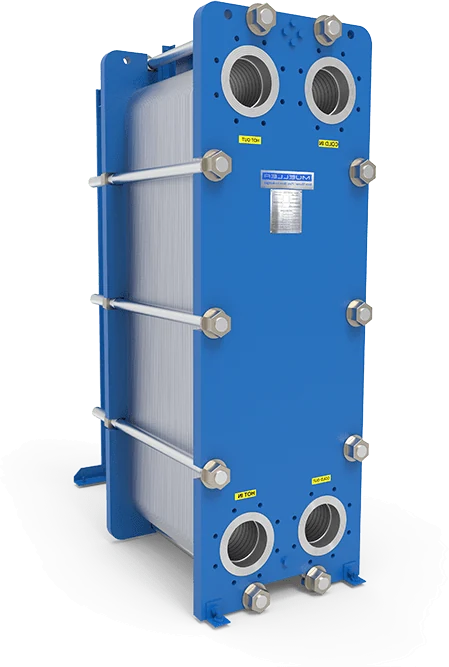
Three checks before a milk exchanger is sized
- Regeneration percent weighed against pack length and pump head
- Pasteurized side held at least 1 psi above raw
- Pasteurized milk leaving at 45°F or below
Milk streams and the construction we start from
Most milk lines end up on gasketed plate. The exceptions are the duties where heat, audit or solids push the product somewhere else.
| MILK STREAM | CONSTRUCTION | WHY |
| Raw milk receiving | Gasketed plate | Single section, close approach, and quick to open for inspection. |
| HTST fluid milk | Multi-section plate frame | Regenerator, heater and cooler sit on one set of tie bars. |
| HTST where the audit wants a visible leak path | Double-wall plate | A breach drains to the plate edge rather than across into product. |
| Lactose-free at ultra-pasteurized heat | UHT tubular shell | Faster browning at 280°F is easier to live with in tubes built for long runs. |
| Evaporated and condensed concentrate | Multi-tube tube-in-tube | Viscosity climbs with solids; large flow area keeps pressure drop in hand. |
Four things every milk quote needs
A milk exchanger can be priced quickly when the request answers four questions. Missing any one of them usually means a call back, and the one most often left out is how long the line runs between cleans.
Flow and run length
Give the rate in gal/h or lb/h and the hours between cleans. A 20-hour HTST run needs more fouling allowance in the heater than an 8-hour shift, and that changes plate count more than most buyers expect.
Temperatures on both sides
- Raw milk in and pasteurized milk out
- Pasteurizing temperature and hold time
- Hot-water, chilled-water or glycol supply and return
Fat and product mix
Skim and whole size alike, but tell us about returned cream, flavored milk with added sugar, lactose-free runs, or any recombined or concentrated stream that shares the frame.
Paperwork and scope
- 3-A 11-10 symbol or a food-grade build
- Grade A under the PMO or manufacturing grade
- Complete unit, new plate pack, or new gaskets
Milk line questions
Yes, in nearly every fluid milk plant. Viscosity between skim and whole differs by well under a factor of two at pasteurizing temperature, so the same pack handles all of them with only a small shift in pressure drop. The product that does change things is cream. If returned cream or a high-fat blend runs through the frame, size the heater and cooler for it or give it its own wide-gap unit.
Protein and mineral deposit form first on the hottest plates in the heater section, where the wall runs a few degrees above the milk. As that layer grows, the hot-water side has to run hotter to keep 161°F at the holding tube. When the heater is short on area, the run ends early. A few extra heater plates, letting the hot water run at a closer approach, usually buy back the lost hours.
For plain fluid milk at HTST temperature, rarely. Plate gives way when the duty runs at ultra-pasteurized or UHT heat, where gaskets and fouling limit run length, when evaporator solids push viscosity up, or when the plant's cleaning program calls for brushing tubes. Those duties move to tubular or straight-tube shell construction, covered on the lactose-free and condensed milk pages.
Yes. We supply new plates, new gaskets and complete new plate packs to fit an existing frame, matched from the plate pattern, plate count, pass arrangement and port sizes. Photos of the nameplate and of one plate, plus the section layout, are usually enough to start. We do not rework or regasket plates you already own; what you receive is new.
Related
Dairy Solutions
Raw Milk Cooling
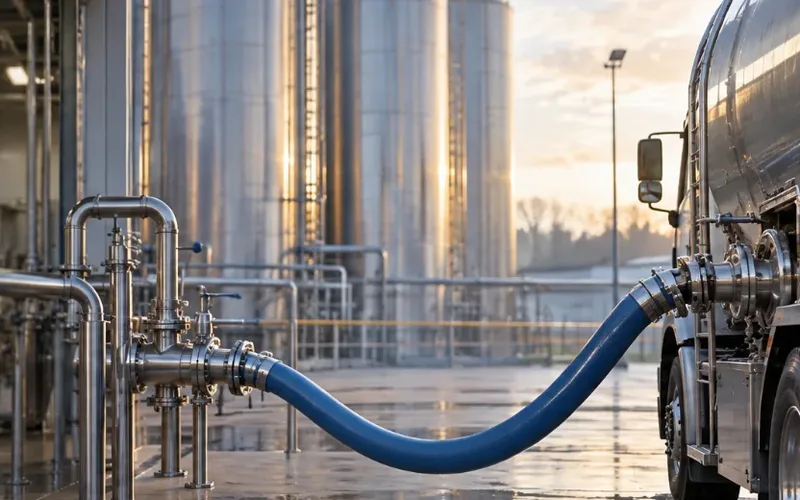
A raw milk cooler on the plant receiving line takes tanker milk to 36–40°F before the silo. Plate sizing, chilled water or glycol, and 3-A build.
+ Learn More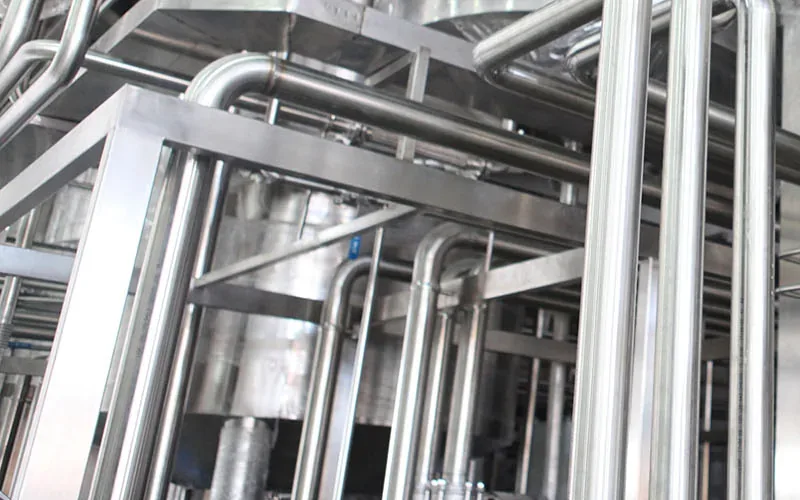
Dairy Solutions
HTST & Regeneration
An HTST plate heat exchanger puts regenerator, heater and cooler in one frame. How regeneration percent, the 1 psi rule and the section layout are sized.
+ Learn More
Dairy Solutions
White Milk
White milk processing runs skim, 1%, 2% and whole milk through one HTST frame. Where standardization and the homogenizer sit, and how the pack is sized.
+ Learn More