
1-805-484-2992
Quotes - Engineering - SalesCooling milk between the tanker and the silo
A receiving duty with a small drop and a big flow
Milk leaves the route cold, but it does not always reach the plant that way. A tanker that waited in the sun at the receiving bay, or one that ran a long pickup route, can arrive near the 45°F limit. Pumping that load straight into a silo means the silo holds it warm into the next day, and psychrotrophic bacteria use the time. A plate cooler on the receiving line pulls each load down to 36–40°F on the way in, so every silo starts at the same temperature no matter which truck filled it.
This is a single-section duty with a small temperature drop and a large flow, which is where a gasketed plate is at its strongest. The milk side runs at unload pump rate, often the highest product flow in the plant, while the drop may be only 5–8°F. The design question is approach. With chilled water at 33–34°F a 2–4°F approach is practical, and the plate count follows from how close you want to get. Glycol reaches colder supply temperatures but costs plates and brings a freezing risk, so we rate both before you choose.
See the Gasketed Plate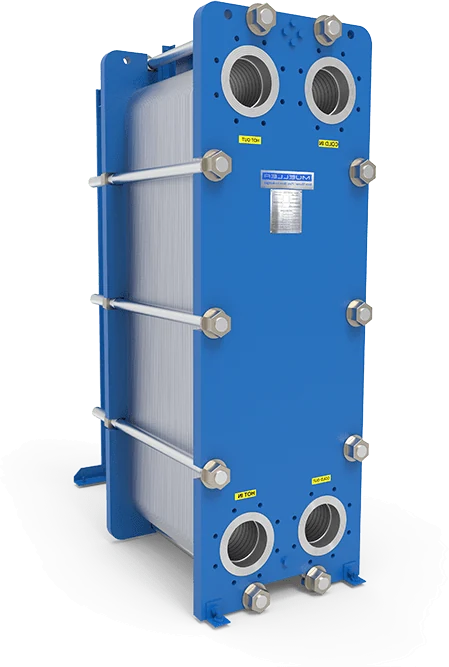
Typical receiving cooler conditions
Starting values for a receiving-line plate cooler. Your tanker temperatures, unload rate and silo target set the final figures.
| Condition | Typical value |
| Raw milk inlet | 40–45°F |
| Raw milk outlet to silo | 36–40°F |
| Chilled water supply | 33–35°F |
| Propylene glycol supply | 28–30°F |
| Approach on chilled water | 2–4°F |
| Approach on glycol | 5–8°F |
| Plate channel gap | 3–5 mm standard dairy pattern |
| Product-contact finish | 32 Ra (about 0.8 µm) |
| Elastomer | EPDM or NBR to FDA 21 CFR 177.2600 |
Sizing the receiving cooler
The load is mostly flow
A receiving cooler moves a lot of milk through a small temperature change. Take 50,000 lb/h cooled from 45°F to 38°F: at 0.93 BTU per lb °F that is about 325,000 BTU/h, or roughly 27 tons of refrigeration at the chiller. The heat load is modest; the hydraulic load is not. Pressure drop at full unload rate, more than heat transfer, often decides the plate count and the pass arrangement.
Chilled water or glycol
Chilled water near 34°F is the safer utility here. Milk starts to freeze at about 31°F, and a glycol supply in the high 20s can build ice on the plates whenever milk flow drops or the unload pump stops while glycol keeps circulating.
- Interlock the glycol valve to the unload pump so the pack cannot freeze between tankers
- Send the chiller's supply and return temperatures, not only its tonnage
- Say whether the same chilled water also serves the pasteurizer cooler, so peak loads do not collide
Where it sits on the receiving line
Most plants put the cooler after the receiving strainer and air eliminator, ahead of the silo valve cluster. It is cleaned with the receiving line, so it must drain completely and accept the line's CIP flow without starving any channel. When raw milk shares a frame with pasteurized product anywhere else in the plant, the wall question is set out on double wall or single wall; on a stand-alone receiving cooler, single wall is the norm.
Size for the worst truck, not the average
Rate the cooler on the warmest load you accept and the fastest unload rate, then check it at the chilled-water temperature the plant actually delivers on a summer afternoon. A cooler sized on average conditions passes milk at 41 or 42°F on exactly the days the silo most needs it cold, and the fix after installation is extra plates that the frame may not have room for. Spare carrying-bar length costs little at purchase.
Questions from the receiving bay
It can if the valve cluster lets you route silo recirculation through it, and some plants do this to bring a silo back down after a slow production day. Size the pack for whichever flow is higher, and confirm that the chilled-water system can carry this cooler and the pasteurizer cooler at the same time when both are running.
Jacket area on a large silo is small compared with its volume, so cooling is slow, and milk near the wall chills first while the center stays warm until the agitator mixes it. A plate cooler on the inlet brings every gallon to temperature before it lands, which is faster and gives a predictable silo temperature from the first hour of filling.
With water-like milk and a single-pass pack, a 2–4°F approach to the chilled-water supply is practical, so 34°F water brings milk to about 36–38°F. Getting closer is possible, but each degree costs a growing number of plates. Most plants settle on 38°F at the silo as the balance between plate count and storage temperature.
Freezing happens when the utility runs below about 31°F and the milk stops moving. Use chilled water above 33°F where you can. On glycol, interlock the glycol valve to the unload pump, keep a minimum milk flow through the pack during changeovers, and avoid an approach so tight that the plate wall sits well under the freezing point of milk.
If the plant is Grade A and the inspector expects 3-A equiptment on the raw side, yes, and we build it to the plate standard, 3-A 11-10. Raw-side equipment is still product contact, so the same 316L, 32 Ra finish, tri-clamp connections and drainable layout apply as on the pasteurizer. Manufacturing-grade plants sometimes accept a food-grade build after checking with their inspector.
Related
Dairy Solutions
HTST & Regeneration
An HTST plate heat exchanger puts regenerator, heater and cooler in one frame. How regeneration percent, the 1 psi rule and the section layout are sized.
+ Learn More
Dairy Solutions
White Milk
White milk processing runs skim, 1%, 2% and whole milk through one HTST frame. Where standardization and the homogenizer sit, and how the pack is sized.
+ Learn More
Dairy Solutions
Lactose-Free Milk
Lactose-free milk processing adds lactase hydrolysis, a sweeter product and faster browning at heat. How that changes the heater, construction and run time.
+ Learn More