
1-805-484-2992
Quotes - Engineering - SalesThe load starts with three numbers
Heat load is mass flow times specific heat times temperature change: Q = m × cp × dT. In the units a dairy plant uses, that is BTU/h from lb/h, BTU/lb°F and °F. The equation is simple. Most sizing errors come from its inputs: a flow quoted in the wrong unit, a peak flow left out, or a temperature taken at the wrong point in the line.
What to send
Plants quote flow three ways: gallons per hour from the HTST or filler rating, gallons per minute from a pump curve, and pounds per hour from a mass flowmeter. Heat transfer runs on mass, so every figure ends up in lb/h. For skim and whole milk we use about 8.6 lb per gallon; heavy cream weighs a little less per gallon because fat is lighter than water.
Temperatures belong on the product side, measured where the exchanger begins and ends, and the outlet should be the temperature you must guarantee rather than the one you hope for.
Flow and temperature fields
- Normal flow and maximum flow, with the unit stated
- Product inlet temperature, worst case for the season
- Product outlet temperature that must be guaranteed
- Section temperatures for a multi-section HTST frame
- Allowable product-side pressure drop
- Hours per run and runs per week
Worked raw milk cooler loadCooling 6,000 gal/h of whole milk from 45°F to 38°F takes about 336,000 BTU/h, which is 28 tons of refrigeration at the chiller.
Working values behind the example
So that the arithmetic on this page can be checked line by line, these are the values it uses:
- Whole and skim milk: about 8.6 lb per gallon
- Whole milk specific heat: about 0.93 BTU/lb°F
- Water: 8.33 lb per gallon, specific heat 1.0 BTU/lb°F
- One ton of refrigeration: 12,000 BTU/h
- Gallons per minute to gallons per hour: multiply by 60
Call and talk it through with an engineer: 1-805-484-2992
A worked example: raw milk receiving cooler
A plant receives raw milk at 45°F, the top of the allowed range, and wants it in the silos at 38°F. The receiving cooler must keep up with 6,000 gal/h. As mass, 6,000 × 8.6 = 51,600 lb/h.
The load is 51,600 lb/h × 0.93 BTU/lb°F × 7°F = 335,916 BTU/h, about 336,000 BTU/h. At 12,000 BTU/h per ton, that is 28 tons of refrigeration the chilled-water plant has to supply whenever the cooler runs.
Now the utility side. Chilled water entering at 34°F and leaving at 42°F picks up 8°F. The water flow is 335,916 / (1.0 × 8) = 41,990 lb/h, about 5,040 gal/h or 84 gpm. That is the figure to check against the chilled-water pump and header before the cooler is ordered.
The cold-end approach is milk out minus water in: 38 minus 34, or 4°F, at the top of the range a plate cooler handles comfortably on chilled water. Ask for 36°F milk from the same water and the approach halves to 2°F. The load rises by only two-sevenths, but the plate count climbs far faster, because the driving temperature difference shrinks at the same time.
The same check runs backward when a plant already owns a cooler and wants more from it. Measure the flow, both product temperatures and both water temperatures on a busy day; the product-side load and the water-side load should agree within a few percent. If they do not, one of the instruments is wrong, and that is worth knowing before anyone sizes a replacement.
Run the same arithmetic for each section of an HTST frame and the loads add up section by section; the regenerator usually carries far more heat than the heater or cooler beside it, which is why it holds most of the plates. Utility and approach covers how the other side's temperatures are chosen.
Agree the guaranteed outlet temperature before the quote, not after the startup.
Send flow with its unit and both product temperatures, and we will return the load and the utility flow with the quote.
Request a QuoteFlow and temperature questions
Either, as long as the unit is stated and the product is named. Gallons are what most HTST ratings and fillers use; pounds are what the heat balance needs. If your flowmeter reads mass, send that. A flow figure with no unit is the single most common reason a quote request comes back with a question.
The warmest one it will see in normal service, usually a summer delivery or a product returning from a warm process step. Sizing on an average inlet leaves the cooler short on the days that matter most. If the line also sees cold inlets in winter, tell us; at the cold end of the year a plate unit can overcool unless the utility is throttled.
The holding temperature comes first: at least 161°F for 15 seconds on milk, with most plants running a degree or two above for margin. The regeneration percentage then fixes the temperatures leaving the regenerator on both sides, and the cooling section finishes at 45°F or below, usually aimed at 36–40°F for shelf life.
Size for the maximum, then check the minimum. At low flow a plate unit makes temperature easily, but channel velocity falls, fouling builds faster and a cooler can drive product colder than wanted. A variable-speed pump or a utility control valve handles most of this; tell us the turndown so the pass arrangement suits both ends.
Yes. Skim sits a little above whole milk, near 0.95 BTU/lb°F, and cream falls as fat rises because fat holds less heat than water. Using the whole milk figure for heavy cream overstates the load slightly, which is safe, but it says nothing about the viscosity problem, which is not. We use a value for each product named in the request.
Related
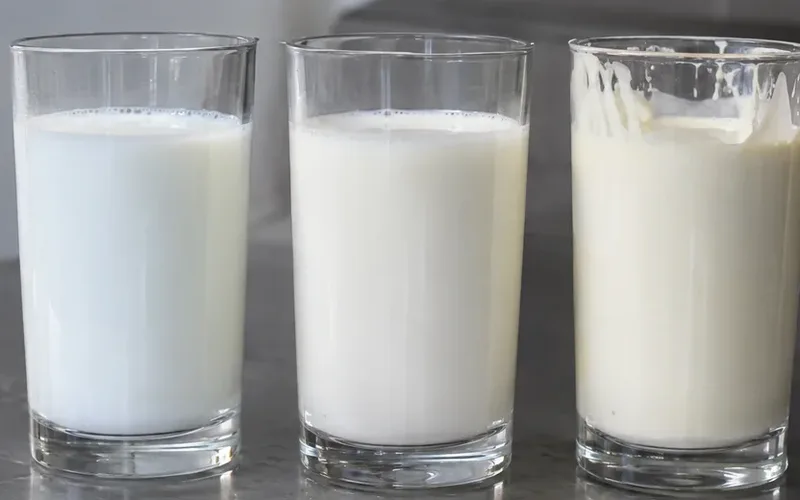
Sizing & Selection
Product, Fat & Solids
How milk fat, total solids, viscosity and particulates change a heat exchanger: what cream fat percent and mix solids do to plate gap, area and gaskets.
+ Learn More
Sizing & Selection
Utility & Approach
Heat exchanger approach temperature for dairy duty: hot water, steam through a hot-water set, chilled water and propylene glycol, and how close each can run.
+ Learn More
Sizing & Selection
Size the Duty
Heat exchanger sizing for milk and dairy product: the product data, flows, temperatures and utility details we need to size the surface and pressure drop.
+ Learn More