
1-805-484-2992
Quotes - Engineering - SalesTwo duties above pasteurizing temperature
Indirect UHT brings milk to 275–300°F through a tube wall and holds it 2–6 seconds before cooling, with pressurized hot water as the heating medium. Nothing is injected, so there is no flash vessel and no water to remove, but the tube wall carries the full temperature step and deposits build fastest there.
The exchanger decides how long the plant runs before it must clean. Regeneration in tubular form, a pre-hold to stabilize whey protein ahead of the final heater, and a hot-water loop held close to product temperature are what stretch a run from a few hours toward a full production day.
Extended shelf life milk is ultra-pasteurized at 280°F or above for at least 2 seconds, then cooled and filled under conditions that keep contamination out.
It still ships refrigerated, so the exchanger has two jobs: reach the ultra-pasteurizing temperature without a cooked note, and cool the product along a path with no dead legs, no undrainable pockets and no leak route from utility into product.
Some plants do run plate packs for UHT, but at 275–300°F the product has to be held well above its vapor pressure, the hot-water side runs hotter still, and protein and mineral deposit shorten a plate run quickly. Where pressure or run length rules out gaskets, tubular and shell-and-tube units take over. Two duties live in this section: indirect heating for shelf-stable product, and ultra-pasteurized milk that still ships cold.
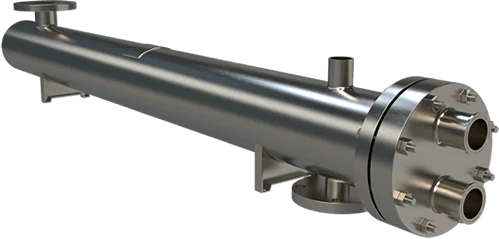
Three conditions that move a dairy heating duty from plate to tube
- Product pressure high enough to stop flashing at the hold
- Protein and mineral deposit that limits a plate run
- Hot-water loop pressure beyond what a gasketed frame carries
Which construction each UHT stream takes
The heater and the coolers on one line can take different constructions. Each row is a section of the line, not a whole plant.
| UHT STREAM | CONSTRUCTION | WHY |
| White milk, indirect UHT heater | UHT and high-pressure shell | Straight sanitary tubes take product and loop pressure without gaskets and run long between cleanings |
| ESL milk, heating and cooling | Multi-tube tube-in-tube | Smooth product at moderate viscosity; a bundle of small tubes keeps the unit short |
| UHT cream and creamers | Corrugated tube-in-tube | Higher viscosity and fat; corrugation lifts the film coefficient at moderate velocity |
| Tubular regenerator, product to water to product | Straight tube and shell | A water loop between raw and sterile product means they never share one wall |
What a UHT exchanger has to survive
A UHT heater sees the highest pressure, the hottest wall and the longest runs in the dairy. Four conditions set its build, and each one is a reason a gasketed frame is a weak fit for the hottest section even where the rest of the line could run on plate.
Pressure on both sides
Milk at 300°F must stay liquid, so the product side runs under back pressure well above saturation. The hot-water loop runs hotter and above its own saturation pressure. Welded tubes and a code-stamped shell carry both without a gasket in the load path.
Deposit and run length
Whey protein deposit builds where milk passes through the denaturing range, and calcium phosphate scale takes over at the hot end. Both widen the approach and raise pressure drop until the plant must clean. Tube velocity and wall temperature decide how fast that happens.
Thermal cycling
A UHT unit swings from cleaning temperature to sterilizing temperature and back every run. Straight tubes grow against the shell, so the design allows for expansion through a shell bellows or a floating tube end.
Code and paperwork
- ASME Section VIII on the shell above 15 psig
- 3-A 12-08 for the tubular product side
- Mill certificates for every 316L product-contact part
- Hydrostatic test records with the unit
UHT line questions
Steam condenses at a fixed temperature for its pressure and gives a very high coefficient, which pushes the tube wall hotter than the milk needs. That speeds deposit and shortens the run. A pressurized hot-water loop lets the wall run only a few degrees above product. The steam-to-water heater on that loop is a utility item, separate from the product-side exchanger.
Some lines do, once regeneration has brought the product down to a modest temperature and pressure. On aseptic product, though, every gasket is a possible way into sterile milk, and a weep that would be a cleaning nuisance on an HTST cooler becomes a non-sterile batch. Most aseptic lines keep the whole path from the hold to the aseptic tank welded and tubular.
Tubular regenerators recover a large share of the heat, though usually a few points less than a plate HTST because tubular units run wider approaches. A product-to-product layout recovers the most. Running a water loop between the raw and sterile streams gives up some recovery and in return keeps the two products from ever sharing one tube wall.
Both, in most plants. The product side is built to 3-A 12-08 tubular criteria with self-draining passages and sanitary connections. The shell and the hot-water side run above 15 psig, so they are designed, built and stamped to ASME Section VIII. We supply the data report and the material certificates with the unit.
Mostly the heater. Milk quality, protein level and pH matter, but the exchanger controls wall temperature, velocity and how long product spends in the denaturing range. A pre-hold ahead of the final heater, a tight hot-water approach and enough velocity to keep the boundary layer thin all push the run longer. Tell us the run the plant needs and we size to it.
Related
Dairy Solutions
Indirect UHT Heating
Indirect UHT heat exchanger for milk: tubular heating on pressurized hot water, tubular regeneration, and a heater sized for long runs between cleanings.
+ Learn More
Dairy Solutions
ESL Milk
ESL milk heat exchanger for ultra-pasteurized, extended shelf life milk: tubular heating to 280°F for 2 seconds and a clean, drainable cooling path.
+ Learn More
Dairy Solutions
Milk
Milk heat exchanger choices for raw milk cooling, HTST pasteurizing with regeneration, vat cooling, and white, lactose-free, recombined and condensed milk.
+ Learn More