
1-805-484-2992
Quotes - Engineering - SalesBefore you send
A quote is only as good as the duty behind it
Most dairy exchanger quotes stall for the same reason: the request names the equipment but not the job. A line that says 'plate heat exchanger, 40 gpm, milk' leaves open whether the milk is raw or pasteurized, what temperature it arrives at and leaves at, what the utility is, whether a regeneration section belongs in the frame, and whether the inspector will want the 3-A symbol. Each of those can move the price by more than the frame itself, so sales has to call back, and the first number you see arrives a week later than it should.
This section is set up so that does not happen. The Quote Checklist walks through every field we price from and says why it matters. Unit, Pack or Bundle settles the scope early: a complete new exchanger, a new plate pack for a frame you already own, or a new tube bundle for a shell that is staying. With those two pages behind you, the request goes in once, and what comes back is a priced construction rather than a list of questions.
If something on the list is unknown, send what you have and say which fields are open. A known gap is quicker to close than a guessed number is to unwind.
Three steps to a priced request
Quote Checklist
- Product, fat percent and total solids, with any fines, pulp or pieces
- Flow in lb/h or gal/h and the product temperatures in and out
- Utility and its supply temperature, regeneration, and 3-A / PMO status
Unit, Pack or Bundle
- A complete new exchanger when the duty or capacity has changed
- New gasketed plates when the frame and its sections still fit
- A new bundle when a sanitary shell is sound and staying in place
Send the Request
- Use the quote form and attach nameplate photos or old data sheets
- List any field you cannot confirm instead of estimating it
- Name the person on site who can answer a process question
Define the product
Fat, solids and anything solid in the stream
Fix the duty
Flow and temperatures on both sides
Settle the scope
Whole unit, plate pack or tube bundle
Send it once
One form, photos attached, gaps flagged
What slows a quote down
Three omissions cause most of the back-and-forth. The first is the utility temperature: without it we cannot set the approach, and the approach decides how many plates a section needs. The second is fat content on anything richer than whole milk, because cream at 40 percent fat behaves nothing like skim once it is cold. The third is the regeneration question, which can add a whole section to the frame.
Who should fill it in
The person who knows the process numbers, usually a process or plant engineer, should own the request. Purchasing can send it, but a quote built from a purchase requisition alone tends to miss the product temperatures and the cleaning regime. If QA has a view on 3-A or double-wall construction, get it before the request goes in, not after the price comes back.
What comes back
A priced construction recommendation: the exchanger type, section layout, plate or tube count, materials, finish, elastomer and connections, with the duty it was sized to written on it. If we would change something you specified, such as an approach closer than the utility can deliver, the quote says so and prices both options.
When to talk first
Some jobs are better started with a conversation: a product nobody in the plant has run before, a line moving from vat to HTST, or a replacement where the old unit has been modified and no one is sure what is in the frame. In those cases an application specialist can work through the duty with you before anything is written down.
Call and talk it through with an engineer: 1-805-484-2992
Before you request a quote
Yes, and it is better than filling them with guesses. Mark the open fields and tell us what you do know around them, such as a flow range instead of a single figure. We will price the most likely case and show what changes if the open number lands at either end. A guessed inlet temperature that turns out ten degrees wrong costs more time than a blank.
Not to price it, but they help when space is tight or the exchanger has to bolt into existing piping. A photo of the area with a tape measure in frame, plus the connection sizes and centerlines, is usually enough at quote stage. Full piping drawings matter later, once the construction is agreed and the layout is being fixed for fabrication.
List each duty seperately, even if you expect them in one frame. A raw cooler, a regenerator and a heater on the same pasteurizer share a frame but have different flows, temperatures and media. We decide whether they combine into one multi-section plate unit or split across two, and the quote shows the section layout either way.
For early capital planning, a product, a flow and the two product temperatures give a reasonable budget range for a given construction. It will not be a firm price, because utility, regeneration and 3-A scope can each move it. Ask for a budget figure explicitly so the quote is labeled that way and nobody mistakes it for a firm number.
Related
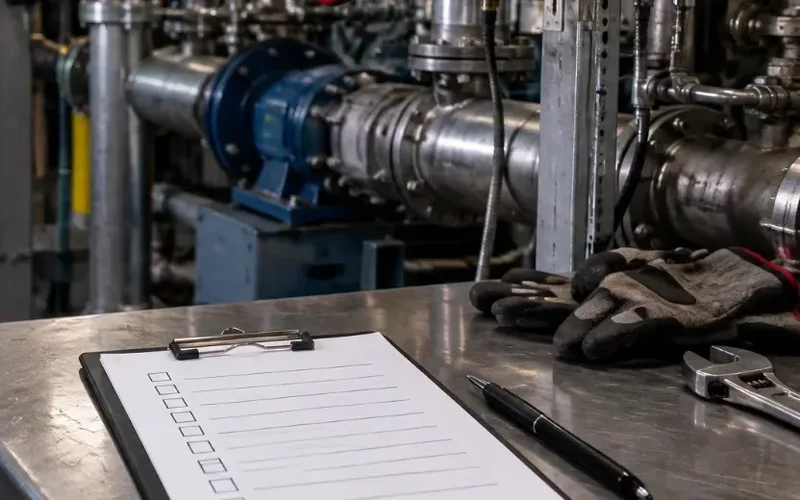
Sizing & Selection
Quote Checklist
A heat exchanger quote checklist for dairy duty: each field we price from, from fat and particulates to approach and 3-A, and why each moves the price.
+ Learn More
Sizing & Selection
Unit, Pack or Bundle
Replacement plate pack vs new unit: when new plates in your frame make sense, when a new tube bundle does, and when a complete new exchanger is better.
+ Learn More
Sizing & Selection
Match the Product
Types of heat exchangers for dairy duty: match the product to plate, wide-gap or tube, then settle double wall and regeneration before sizing surface.
+ Learn More