
1-805-484-2992
Quotes - Engineering - SalesTwo walls between raw and pasteurized
A single-wall plate puts one thin sheet of 316L between raw and pasteurized milk. When that sheet cracks at a port or along a contact point, nothing outside the frame changes. Product passes through an opening too small to see, and the plant learns about it from a lab count or a dye check, often weeks later.
A double-wall plate is two plates pressed together as a pair, with a thin interspace between them that is open to atmosphere at the plate edge. If either sheet cracks, the fluid that gets through fills the interspace and runs out at the side of the pack, where an operator walking past will see it. Raw and pasteurized milk cannot meet through a single failure.
At the ports each product sits behind its own gasket, with a vented space between the two seals, so a failed gasket drips to the floor instead of crossing over. We build double-wall plates into regenerators, into coolers that run on propylene glycol, and into any section where a QA plan will not accept one sheet and one gasket as the only barrier.
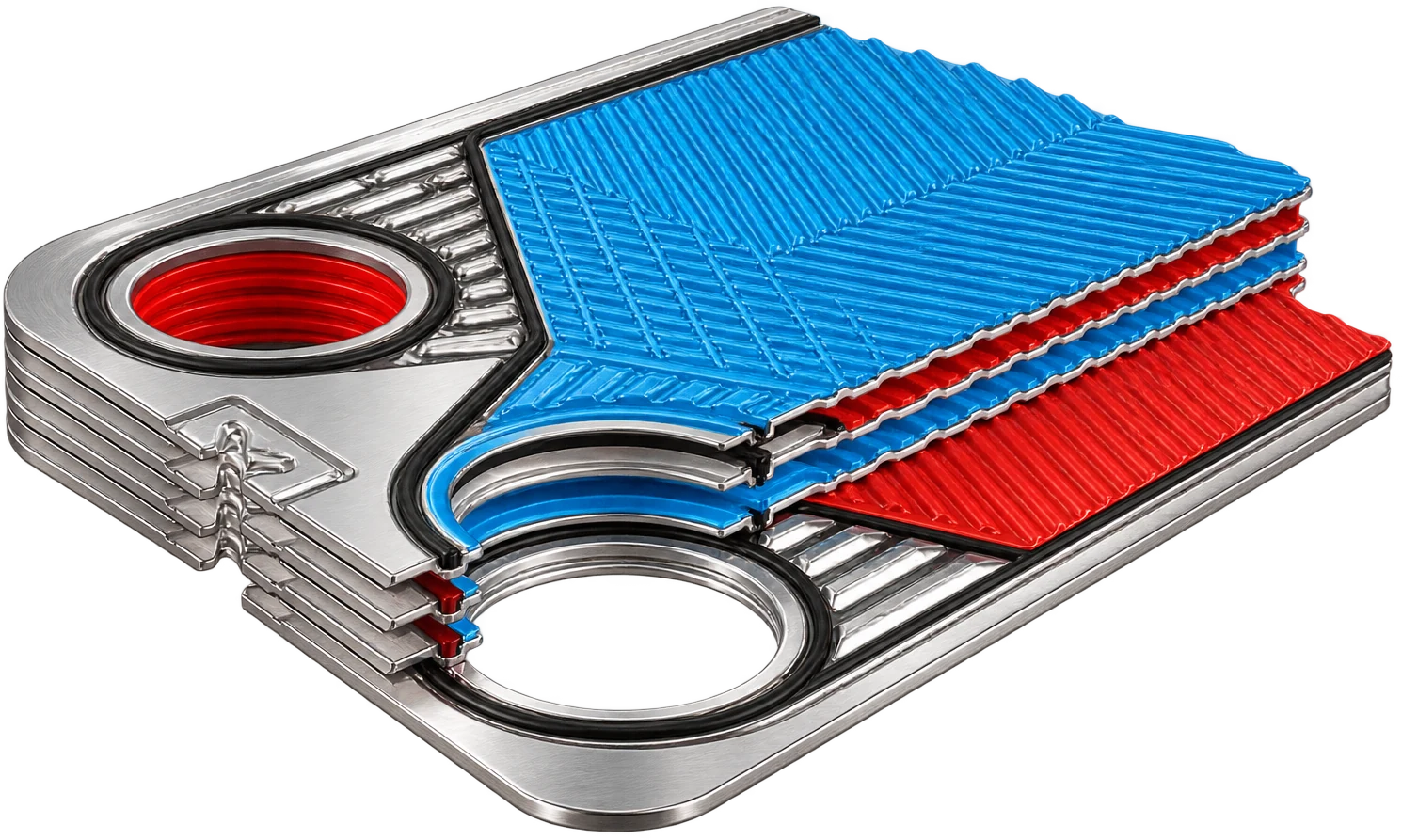
With a double-wall plate a crack becomes a drip at the edge of the pack, seen on the next walk-past instead of found in a lab count.
Two sheets and a vented interspace between raw and pasteurized.
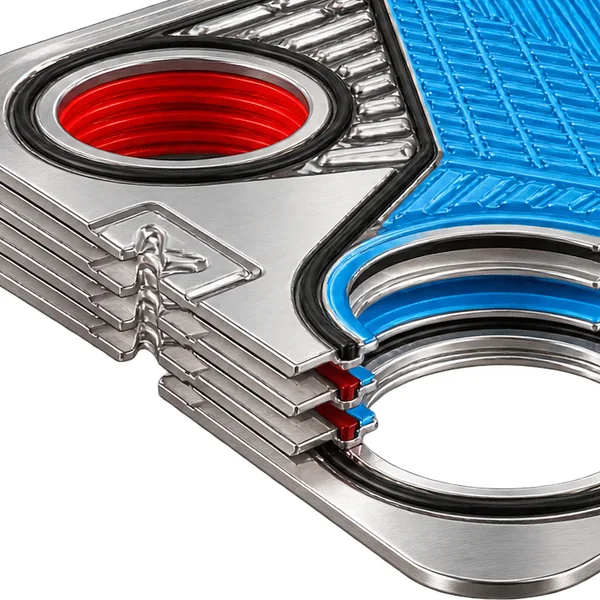
The vented plate pair
- Two nested 316L sheets for every heat transfer wall
- Interspace vented to atmosphere at the plate edge
- A leak through either sheet shows outside the pack
- Same frame, bars and bolts as a single-wall pack
- Double-wall sections can share a frame with single-wall ones
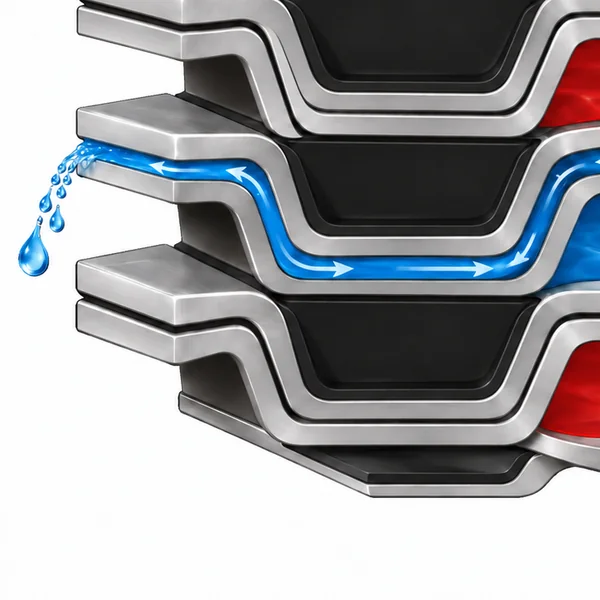
Port seals with a telltale
- A separate gasket around each product port
- Vent slot between the two seals drains outside
- No point where one gasket alone parts raw from pasteurized
- Clip-in gaskets in EPDM, NBR or HNBR
- Drip points visible from the operator side of the frame
What you specify




Double-wall plate, standard build
The build we quote for a double-wall regenerator or glycol cooler unless your QA plan asks for more.
| Feature | Standard build |
| Plate construction | Two pressed 316L sheets per wall, vented interspace |
| Product-side finish | 32 Ra; 20 Ra on request |
| Port sealing | Double gasket with a vented leak path |
| Where fitted | Regenerator, glycol cooler, or any section QA names |
| Gaskets | EPDM, NBR or HNBR to FDA 21 CFR 177.2600 |
| Connections | Tri-clamp, drainable product side |
| Regenerator pressures | PMO 1 psi margin still applies |
| Testing | Hydrostatic test of each side before shipment |
| Standard | Built to 3-A 11-10 where the inspector expects it |
Where the second wall earns its area
In the regenerator
The PMO handles a regenerator leak by direction: the pasteurized side runs at least 1 psi above the raw side, so a crack lets pasteurized milk into raw rather than the reverse. That protects the product, but the crack is still there, still hidden, and still growing. A double-wall regenerator adds a second barrier and turns the failure into something the crew can see before the next run.
On glycol and other non-potable media
A final cooler on propylene glycol puts a non-food fluid on the other side of one sheet from finished milk. A crack there is a recall, not a quality note. Plants that cool on glycol, or on tower water of uncertain quality, fit double-wall plates to that section first, and often only to that section. See double wall or single for how to weigh it section by section.
What the second wall costs
The interspace adds thermal resistance, so a double-wall section needs more plates than a single-wall one for the same duty, and the pack runs longer on the bar. Each plate pair also costs more than a single plate. For that reason most plants fit double wall where a crossover would matter and leave the heater, which runs potable hot water, in single wall.
Looking after a double-wall pack
The protection only works if the leak path stays open and someone looks at it.
- Check the plate edges for wet streaks after every run
- Trace any drip to its plate pair before production restarts
- Replace a leaking pair; never seal or tape the vent
- Keep insulation and guards clear of the interspace edges
Double-wall questions
Do not plan on it. The PMO pressure rule is written for milk-to-milk regenerators whatever the plate construction, so keep the timing pump, booster pump interlocks and differential recorder as they are. The double wall is an added barrier and a way to see a failure; any layout that leans on it in place of the pressure controls is for your regulatory agency to accept before the order is placed.
The drip comes out at the edge of the pair that has failed, so its position along the pack points straight to it. Mark the plate pairs with their hang numbers, wipe the pack dry, run water on one side and watch for the first wet edge. A drip at a port corner rather than along the plate usually means a port gasket, not a cracked sheet.
Sometimes. Double-wall pairs are thicker than single plates, so the same plate count makes a longer pack, and the bars and bolts must have room for it. The plate pattern also has to suit the frame's port size and bar spacing. We check the frame data before quoting new double-wall plates for it, and quote a new frame when the existing one is too short.
The product channels have the same shape as a single-wall pack, so CIP flow, temperature and chemistry stay the same. The interspace never sees product or detergent unless a sheet has failed. If a leak has occurred, flush and inspect that pair before reuse, because the interspace is not designed to be cleaned in place and will hold whatever got in.
Usually not. The heater runs potable hot water against milk that is about to be held and diverted if it falls short, so a small leak there is far less serious than in the regenerator or the glycol cooler. Plants that treat the hot-water loop with chemicals not suited to food contact sometimes choose double wall in the heater as well.
Related
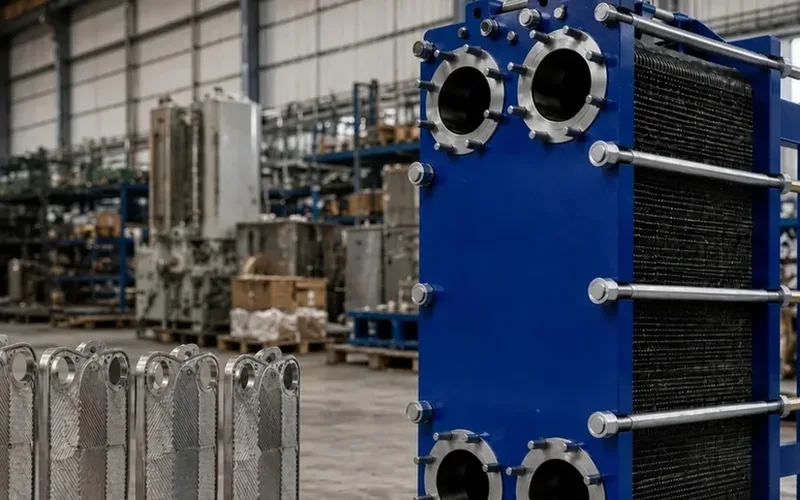
Heat Exchangers
Multi-Section Frames
HTST plate heat exchanger with regenerator, heater and cooler sections in one frame, split by connector plates with sanitary section ports.
+ Learn More
Heat Exchangers
Wide-Gap Plate
Wide gap plate heat exchanger with 6–12 mm product channels for cream above about 30 percent fat, ice cream mix and product that carries fines.
+ Learn More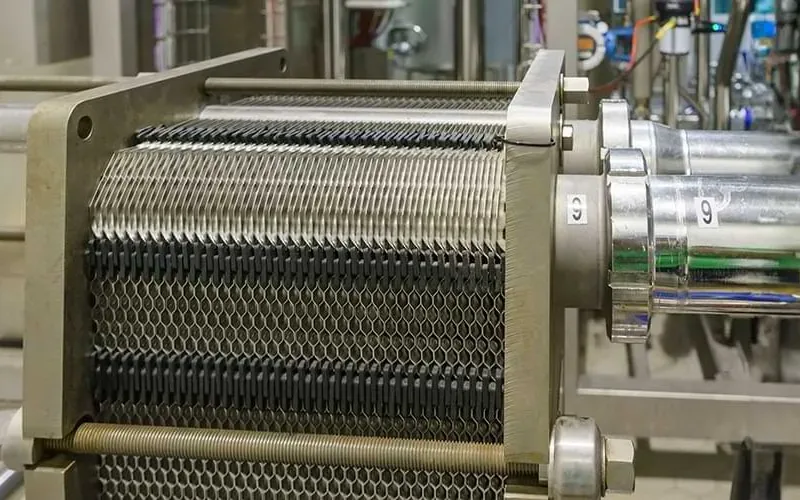
Heat Exchangers
Gasketed Plate
Plate and frame heat exchanger for dairy: gasketed 316L plates for fluid milk, whey and cream, with frames laid out for HTST sections and CIP.
+ Learn More