
1-805-484-2992
Quotes - Engineering - SalesClean-in-place starts at the ports
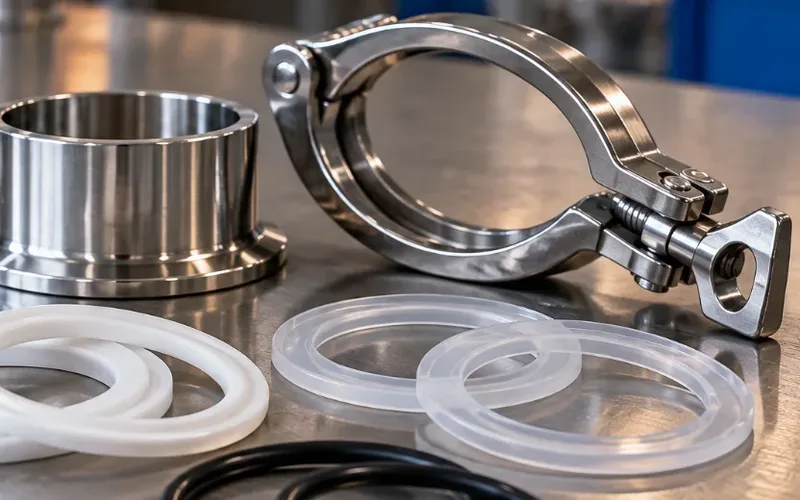
Every product connection on our dairy units is a tri-clamp ferrule: a flanged sanitary end, a gasket and a hinged clamp, with the ferrule bore matched to the tube bore so there is no step for product to sit behind. It comes apart by hand for inspection and goes back together without a machined seal face to damage.
Drainability is the other half of the job. When the CIP circuit stops, the product side should empty by gravity to a low point. A plate pack drains through its bottom ports when the frame is piped with the ports placed for it. A tubular stack drains only if it is built and set with a continuous fall, typically 1/16 to 1/8 in per foot, or stood vertical.
This page is also where cleaning-in-place design for the exchanger itself belongs. The CIP skid, its tanks and its controls are the plant's. What the exchanger controls is whether that circuit can reach every product surface at cleaning velocity and then drain away. Getting that right is decided when the unit is sized, not on the day it is commissioned.

Three checks before the unit joins the CIP circuit
- Every product port a sanitary clamp, no threads
- A fall to one drain point with no trapped low spot
- Cleaning flow at or above production flow
Connection and drain details we build to
These are the defaults on our dairy units. Plants with a house standard for clamp size or gasket material should send it with the request so the ends arrive ready to bolt into existing piping.
Connections
- Product ends: Tri-clamp ferrules in 316L
- Common sizes: 1.5, 2, 2.5, 3 and 4 in
- Clamp gaskets: EPDM, NBR or PTFE by service
- Bore match: Ferrule bore equal to the tube bore
- Instrument ports: Short sanitary tees, close-coupled
Draining and CIP
- Tubular fall: 1/16–1/8 in per foot, or vertical
- Plate pack: Drains through the low ports
- Dead legs: About two diameters or shorter
- Tube CIP velocity: About 5 ft/s or more
- Regenerator: Both sides washed in the same cycle
Designing the exchanger for clean-in-place
Cleaning velocity is a sizing decision
A tube cleans when the wash moves fast enough to scour it; about 5 ft/s is the usual target. A multi-tube unit sized for low pressure drop in production can have so many parallel tubes that the plant's CIP pump cannot reach that velocity through them. We size the tube count against both the production flow and the CIP flow the plant can supply, so the exchanger does not become the part of the circuit that never comes clean.
Plate packs are less sensitive, but the same logic holds: the wash should run at least at production flow through every section, including the regenerator on both its raw and pasteurized sides.
Where water hides
Standing water after a wash is the first sign that a unit or its piping will not drain. These are the places we find it most often on a site visit.
- The lowest return bend of a stack set without fall
- A concentric reducer on a horizontal line
- An instrument tee pointing upward off the flow
- A connector-plate port piped above the section it drains
- A gauge or sensor well installed too far off the line
Clamp joints that stay sanitary
An over-tightened clamp squeezes the gasket into the bore, leaving a lip that collects soil; an under-tightened one weeps. Gaskets that have taken a set should be replaced rather than reused, and the clamp gasket compound should match the duty in the same way the plate gaskets do. Misaligned ferrules on a long pipe run put a side load on the joint, which is why the piping is carried on it's own supports and never hung from the exchanger's connections.
What sits around the exchanger
A Grade A pasteurizer also needs a holding tube, a flow-diversion device and the controls that run them, and the CIP system needs its own supply and return. Those come from the plant's process and CIP suppliers. Our part is to make sure the exchanger's ports, fall and velocities fit them; the PMO and Grade A pages cover the rules they answer to.
Connection and drain questions
Not on the product side of our dairy units. Threads hold soil in their roots, and a standard flange leaves a crevice at the gasket. Tri-clamp ferrules give a flush joint that a wash sweeps clean and that opens by hand. The utility side can use flanged or threaded connections where the piping and the pressure call for them.
Each plate channel drains to its lowest port, so the frame drains as long as the product ports at the bottom of each section are open to a drain or piped to fall away. Frames that have product leaving only from top ports need a low-point drain added in the piping. We show the drain points on the frame drawing.
Either reduce the number of parallel tubes so each sees more velocity, which raises production pressure drop, or split the unit into passes that are washed in series. Sometimes a larger CIP supply is the right answer. Tell us the CIP flow and pressure available at quote stage and we will size the tube arrangement around it.
A vertical unit drains without depending on how carefully it was shimmed, which is a real advantage. It needs headroom and access from above for inspection, and some plants do not have either. A horizontal stack with a built-in fall does the same job when it is installed properly, and it is easier to reach.
We size the ferrules to the product line, usually from 1.5 to 4 in on dairy duty. Where the plant has standardized on a size, matching it avoids adapters and the extra joint each one brings. Large plate frames may carry bigger ports on the frame with sanitary reducers to the line size the plant runs.
Related
Materials & Certifications
316L & Elastomers
Why a 316L dairy heat exchanger, and how EPDM, NBR and HNBR gaskets are matched to product fat, wash chemistry and heat. FDA-compliant compounds only.
+ Learn More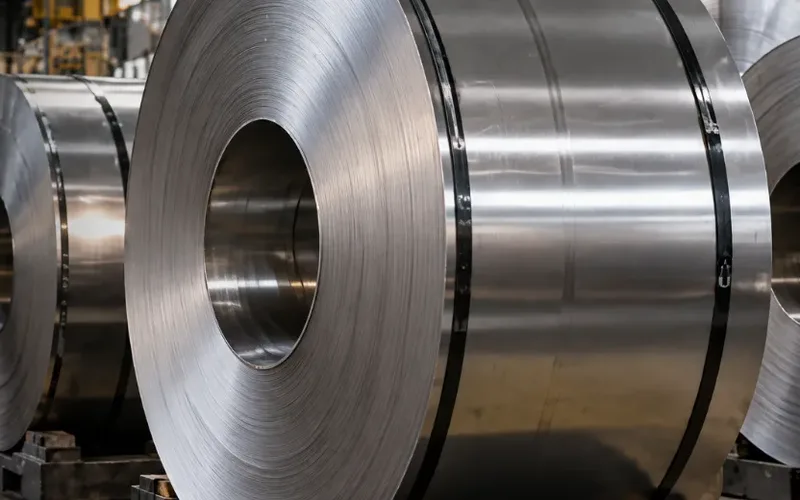
Materials & Certifications
32 Ra or 20 Ra Finish
A 32 Ra surface finish is the dairy heat exchanger standard, and 20 Ra goes on when the audit asks. Where finish is measured, where it slips, what it adds.
+ Learn More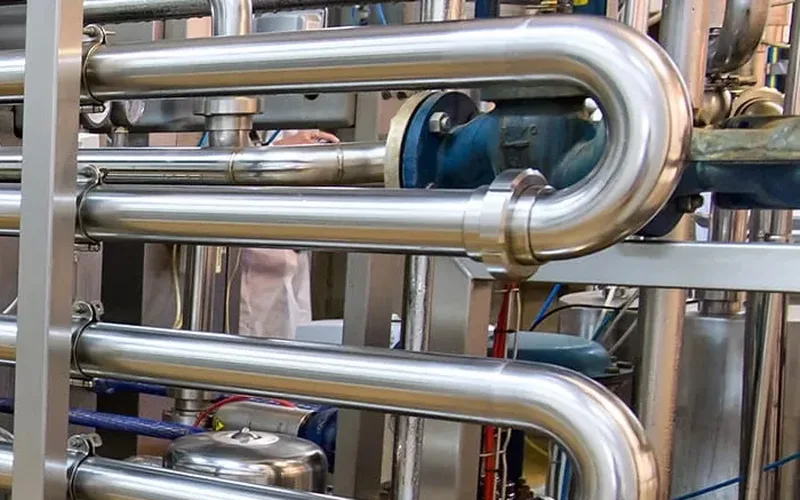
Materials & Certifications
Sanitary Design
Sanitary heat exchanger design for dairy: 316L product contact, matched elastomers, a 32 Ra finish, tri-clamp ends and a product side that drains.
+ Learn More