
1-805-484-2992
Quotes - Engineering - SalesA pasteurizer that stops warm
Heating, regeneration and a trim section aimed at the vat
Cheese milk differs from bottled milk at the outlet. A fluid milk HTST sends product to cold storage at 36–40°F; a cheese milk pasteurizer sends it to the vat at set temperature, typically 86–95°F, so starter and rennet can go in as soon as the vat fills. That changes the whole heat balance. Far less cooling is needed, and the regenerator can only pull pasteurized milk down as far as set temperature, which caps regeneration well below the figure common on bottling lines.
The heating side follows the PMO: 161°F for 15 seconds through a holding tube, with the pasteurized side of the regenerator held at least 1 psi above the raw side. Some plants thermize instead, warming raw milk to roughly 135–155°F for about 15 seconds to knock back psychrotrophs ahead of a later full pasteurization. Thermization is not pasteurization, and the frame has to be sized for whichever duty the plant actually runs.
Cheese yield follows protein and fat recovery, so the exchanger should neither churn fat nor bake protein onto the heater plates. A hot-water heater held 2–5°F above the outlet keeps the plate wall close to milk temperature.
See the Multi-Section Frames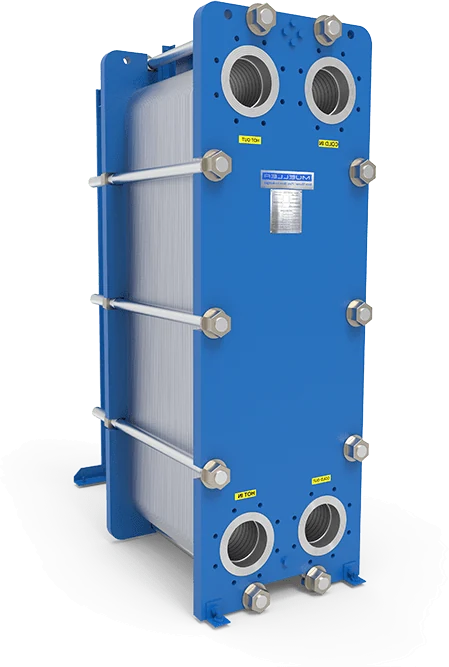
Typical cheese milk duty
These are the figures we start from before a plant's own make sheet replaces them. Set temperature varies most, so send the whole range.
| Condition | Typical value |
| Raw milk at the frame inlet | 45°F or below, often 36–40°F |
| Pasteurizing | 161°F for 15 seconds |
| Thermization, where used | about 135–155°F for roughly 15 seconds |
| Set temperature at the vat | 86–95°F by variety |
| Cheddar set point | near 88°F |
| Regeneration with a warm outlet | around 55–65% |
| Trim section utility | tempered or tower water |
| Heater approach on hot water | 2–5°F above the outlet |
| Gaskets | EPDM at cheese milk fat levels |
Sizing the frame around the make schedule
Why regeneration tops out early
With raw milk arriving at 40°F and the vat calling for 88°F, the pasteurized stream can give up only the heat between 161°F and 88°F. That lifts the raw side to about 113°F, which works out near 60 percent regeneration. Pushing further would chill the pasteurized milk below set temperature and force a reheat. The heater carries the rest, so its plate area is larger than on a bottling frame of the same flow.
The section-by-section heat balance for a cheese milk HTST, with worked temperatures, is set out on our cheese milk heating page.
Variety changes and the trim section
A higher set temperature leaves the pasteurized milk hotter out of the regenerator, so the raw side gains less and the heater works harder. A lower set temperature does the opposite and loads the trim section. When a plant alternates cheddar with a higher-set variety, the frame has to be right at both ends of the schedule.
- Heater area sized at the highest set temperature on the schedule
- Trim area sized at the lowest set temperature
- Modulating valve on the tempered-water side, not on product
- Outlet sensor placed close to the line feeding the vats
Thermization ahead of silo storage
Plants that hold raw milk a day or more before the make sometimes thermize at receiving, then cool straight back to silo temperature. That frame lands cold, not warm, so it looks more like a fluid milk unit than a cheese milk one, and full pasteurization still follows before the vat. If both duties are on the plan, quote them as two frames; one frame swinging between a cold and a warm outlet rarely holds either well.
What protects yield
Burn-on in the heater raises pressure drop, widens the approach and, in time, shortens the run. Whether the regenerator should run milk-to-milk at all, or whether a once-through layout with a water loop suits the plant better, is weighed on regeneration or once-through. Either way, tell us how many hours the make day needs between cleanings so the heater velocity and approach are chosen to hold that run.
Before you size for cheese milk
Only one outlet temperature at a time. Plants that fill a cheddar vat and a higher-set vat back to back retune the trim section between fills, which costs a few minutes of recirculated flow. If fills overlap, a second trim section on its own outlet line is cleaner than chasing a single setpoint up and down all shift.
No. Cheese milk is standardized to a protein-to-fat ratio, not to cream levels, so EPDM handles it and also tolerates the hot caustic and acid of the cleaning cycle. NBR is worth its shorter life in CIP chemistry only when the same frame will also run cream or a high-fat blend on other days.
Run length is set by protein deposit in the heater and the hot end of the regenerator, and by the cleaning interval the plant's regulatory program allows. Tell us the hours the make schedule needs and we choose plate velocity and hot-water approach to hold the duty for that run, rather than leaving the plant to find the limit at hour ten.
Where the inspector expects the symbol, the frame is built to 3-A 11-10 and carries it. Many manufacturing-grade cheese plants ask for it anyway, because it settles drainability and finish questions before an audit. The difference in cost is mostly inspection and paperwork, not stainless steel or plate count.
Usually not. Chilled water at a cheese milk outlet of 86–95°F gives a huge temperature difference, so a small change in water flow swings the product several degrees. Tempered or tower water with a modulating valve holds set temperature far more steadily and leaves the chilled-water plant for the duties that need it.
Related

Dairy Solutions
Yogurt & Cultured Product
Tube in tube yogurt cooling after the break, plus plate heating of the milk base to 185–195°F and cooling to incubation temperature.
+ Learn More
Dairy Solutions
Sour Cream
Sour cream processing heat exchangers: NBR-gasketed plate to pasteurize the cream and reach culture temperature, tubular cooling once it has cultured.
+ Learn More
Dairy Solutions
Cottage Cheese
Cottage cheese heat exchangers for skim milk pasteurizing, curd wash water chilling and cream dressing pasteurized at 166°F, then cooled to 40°F or lower.
+ Learn More