
1-805-484-2992
Quotes - Engineering - SalesA plate that keeps cream moving
Heavy cream at 36–40 percent fat flows easily at pasteurizing temperature and thickens as it cools. In a 3–5 mm milk channel that change shows up first at the cold end of the cooler: pressure drop climbs, flow spreads unevenly across the pack, and the channels nearest the port carry most of the cream while the far channels slow down and foul.
A wide-gap plate opens the product channel to about 6–12 mm and cuts the number of contact points that hold a fiber, a fat cluster or a cocoa particle in place. We press the product side wide and keep the utility side at a normal gap, so hot water or glycol still moves fast enough to hold a useful film coefficient.
That makes the wide-gap pack the plate answer for cream above about 30 percent fat, for ice cream mix at its 175°F or 180°F HTST, and for flavored milk and mixes that carry fines. It stops being the answer once pieces, pulp or broken curd enter the stream; those go to a tube.

A wide-gap pack keeps the cold end of a cream cooler open, with fewer contact points for fat and fines to hang on.
The plate option for product a milk channel cannot pass.
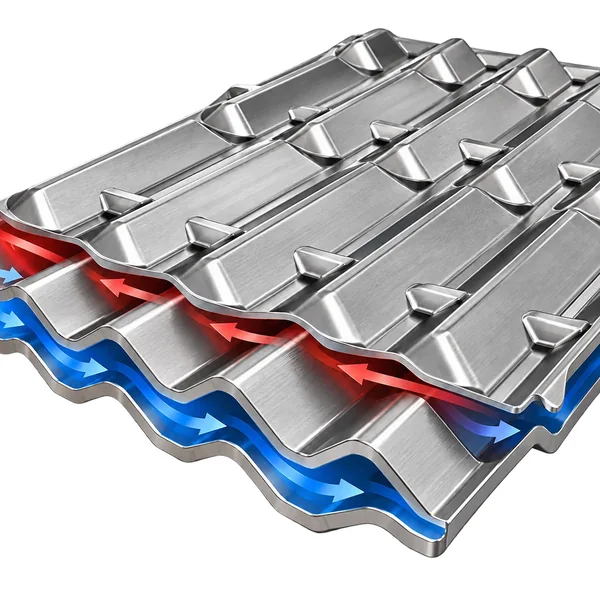
Asymmetric channels
- Product channel about 6–12 mm, utility side kept narrow
- Fewer contact points across the product flow path
- Free-flow pattern where fines are heavy
- Distribution area shaped to spread viscous product
- Plates hung in the same frame style as milk packs
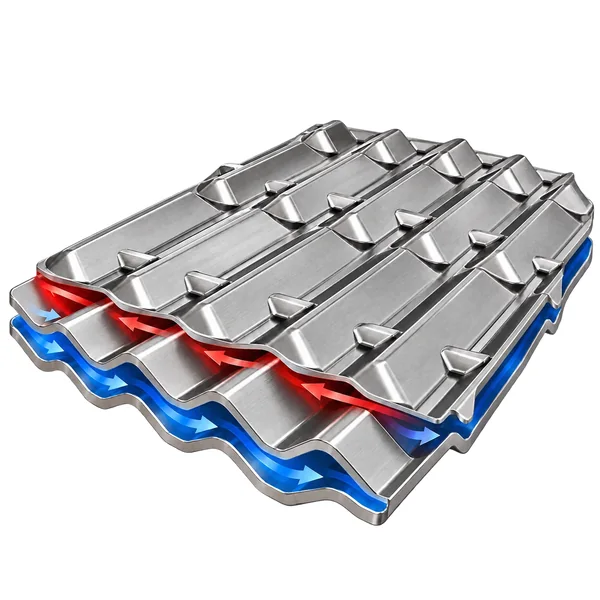
Seals for high fat
- NBR gaskets where cream fat would swell EPDM
- HNBR where one pack sees both hot CIP and high fat
- Clip-in gaskets, no adhesive in the product groove
- Drainable ports, tri-clamp on the product side
- Gasket compound recorded in the documentation package
Specify the gap




Wide-gap pack, standard build
The wide-gap build we quote for cream and mix unless the duty needs something else.
| Feature | Standard build |
| Product channel | About 6–12 mm; free-flow wider on request |
| Utility channel | Standard narrow gap for velocity |
| Plate material | 316L, 32 Ra product contact |
| Gaskets | NBR for cream; HNBR or EPDM by duty |
| Typical product | Cream over about 30% fat, ice cream mix, milk with fines |
| Connections | Tri-clamp, drainable |
| Sections | Heater and cooler; regenerator where the product allows |
| Standard | Built to 3-A 11-10 where the symbol is expected |
Running cream and mix through a wide gap
Size the cold end, not the hot end
Cream that pours like milk at 166°F behaves very differently at the 36–40°F the cooler delivers. Pressure drop and distribution have to be calculated at the outlet viscosity, which is why we ask for the fat percent and the final temperature rather than a single viscosity figure. A cream cooler sized on milk properties will pass its water test at the shop and choke at start-up.
Ice cream mix
Mix carries fat, sugar, milk solids and stabilizers together, and it is pasteurized hotter than milk: 175°F for 25 seconds or 180°F for 15 seconds on HTST. After the homogenizer it is cooled to 36–40°F for aging. The wide gap keeps the stabilized, thickening mix moving through the cooler without the channel-by-channel starvation a milk plate shows. More on the duty is on the ice cream mix page.
Choosing the gasket compound
Butterfat swells EPDM, and a swollen gasket rolls out of its groove the next time the pack is opened. On cream above about 30 percent fat we fit NBR, which resists fat but ages faster under hot caustic. Where one frame runs cream, then a hot CIP, then flavored milk, HNBR covers all three at a higher price per set. Tell us every product the pack will see, not only the hardest one.
Where the wide gap ends
Fewer contact points also mean less support between plates, so a wide-gap pack carries a lower pressure rating than a milk pack. And no plate channel is the right home for discrete pieces. When the duty brings either, it moves to tube-in-tube.
- Fruit pieces, nuts or inclusions in the stream
- Yogurt or sour cream after the break
- Product pressure beyond the pack's rating
- A plant rule that every surface be brushed
Wide-gap questions
About 30 percent is where we start to reccomend it. Half-and-half and light cream run well on a standard milk channel. Between 30 and 36 percent the choice depends on how cold the cream must leave and how long the run is. Heavy cream at 36–40 percent, cooled to storage temperature, belongs on a wide gap.
Yes. A cream-to-cream regenerator on wide-gap plates is common, though it reaches a lower regeneration than a milk frame because the thicker product holds a wider approach. On a Grade A line the same PMO rule applies: the pasteurized side runs at least 1 psi above the raw side, and the layout is set up to hold that margin.
You can, and on high-pressure or particulate duty you should. On smooth cream a wide-gap plate needs less area, holds a closer approach, takes less floor space and opens for inspection in minutes. A tubular unit wins when pieces, pressure or a brushing rule are in play, not simply because the product is thick.
It passes fines: cocoa, fiber, small stabilizer clusters and similar material well below the gap. It is not meant for discrete pieces. As a working rule, anything you could pick out with a spoon goes to a single-tube unit, whose bore passes pieces up to about 1 in, rather than through any plate channel.
It cleans well, provided the CIP supply is sized for it. A wider channel needs more flow to reach the same cleaning velocity, so a CIP set sized for a milk frame may fall short on a wide-gap pack of the same plate count. Give us the CIP flow you have and we will check it against the pack.
Related
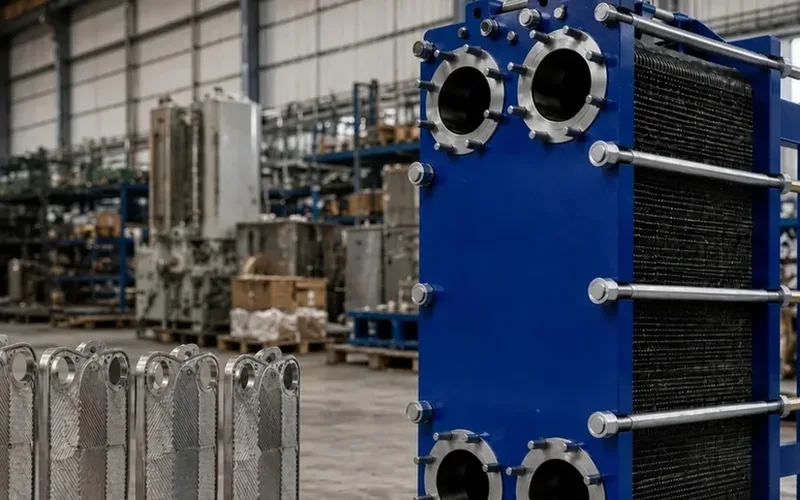
Heat Exchangers
Multi-Section Frames
HTST plate heat exchanger with regenerator, heater and cooler sections in one frame, split by connector plates with sanitary section ports.
+ Learn More
Heat Exchangers
Double-Wall Plate
Double wall plate heat exchanger for dairy: two pressed sheets per wall with a vented gap, so a crack leaks to atmosphere instead of into milk.
+ Learn More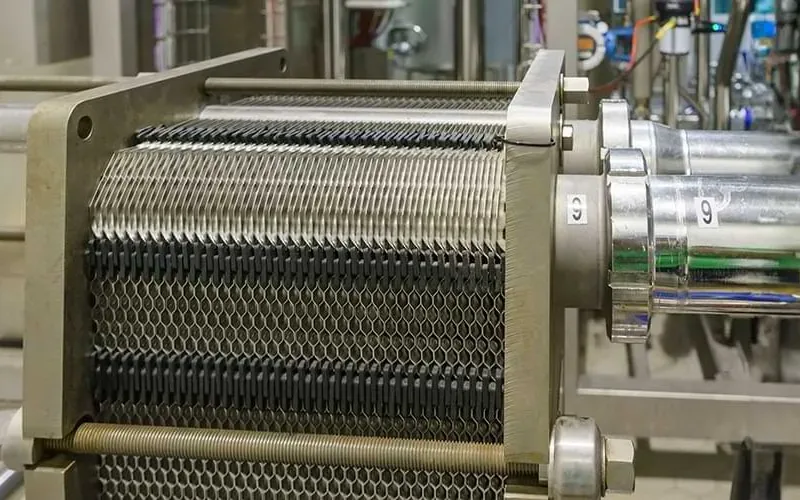
Heat Exchangers
Gasketed Plate
Plate and frame heat exchanger for dairy: gasketed 316L plates for fluid milk, whey and cream, with frames laid out for HTST sections and CIP.
+ Learn More