
1-805-484-2992
Quotes - Engineering - SalesTurbulence without the velocity that wrecks a curd
Stirred yogurt leaves the incubation tank at 108–112°F as a broken curd that is thick, shear-thinning and easily damaged. It has to come down to about 40–45°F, or to 60–75°F first where the plant protects texture, and a tight plate channel squeezes enough body out of it to show in the cup. A smooth tube is gentle but slow: the product runs laminar, heat crosses a thick boundary layer by conduction alone, and the cooler grows long.
A corrugated tube has a shallow helical groove rolled into its wall. The groove turns the flow near the wall and breaks up that boundary layer at a modest velocity. A smooth tube would need far more speed, and far more shear, to match it, so the corrugated unit does the duty in less length and less residence time while the product sees a gentle swirl. We use it on stirred and drinkable yogurt, kefir, sour cream, quark and cultured buttermilk.
Corrugation depth is chosen per product: deeper for thick product that needs more mixing, shallower where texture comes first.
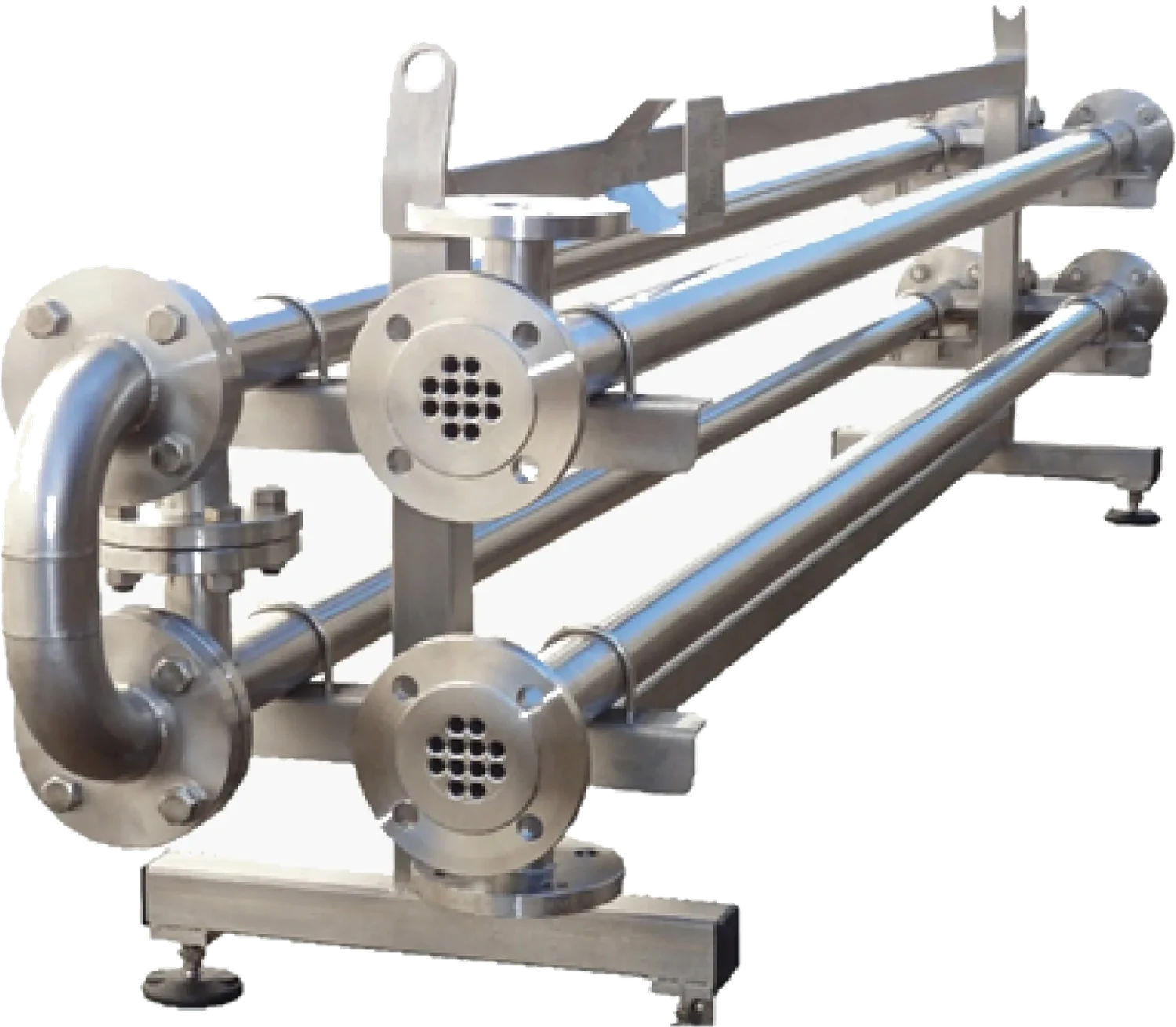
A corrugated wall moves heat through thick cultured product at a velocity low enough that the cup still shows the body QA signed off.
Less length than smooth tube, less shear than a plate.
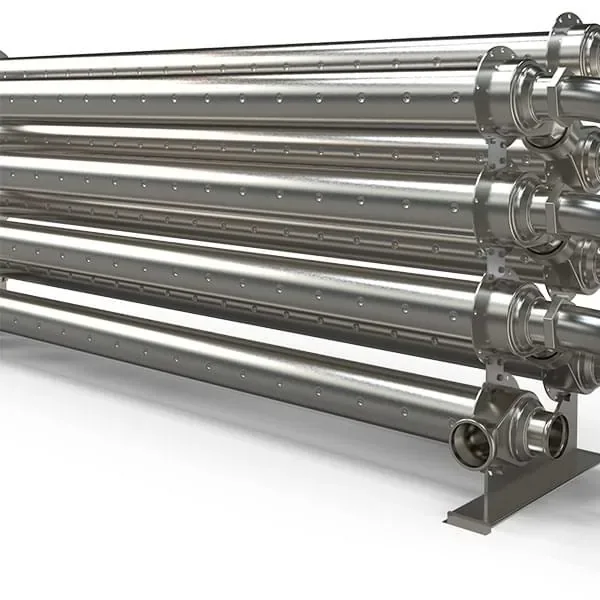
The corrugated product tube
- Helical corrugation rolled into 316L tube
- Depth and pitch matched to product viscosity
- 32 Ra inside the groove, 20 Ra on request
- Fully drainable when the train is pitched
- Inner tube 1–4 in to suit flow and body
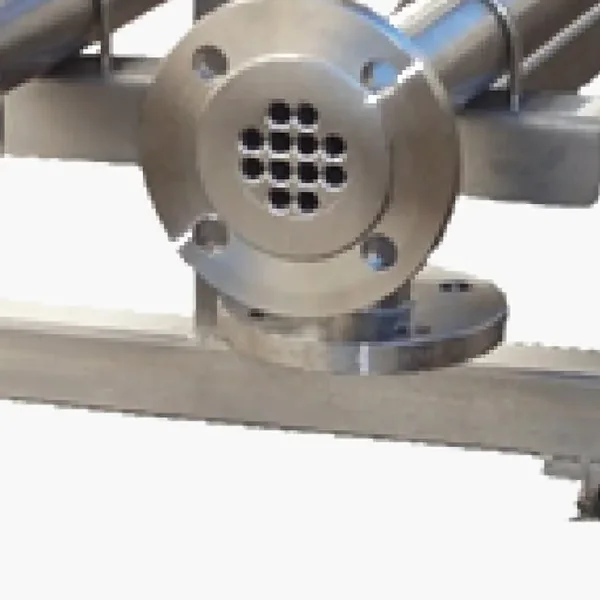
The cooling jacket
- Chilled water or propylene glycol, counter-current
- Glycol held above the product's freezing point
- Two cooling sections when texture calls for it
- Insulated jacket for cold duties on request
- ASME Section VIII jacket above 15 psig
Set for your product




Corrugated tube standard build
The corrugation profile is set per product once we have its viscosity; everything else starts from here.
| Feature | Standard build |
| Product tube | 316L corrugated, 1–4 in |
| Corrugation | Helical, depth set by product viscosity |
| Product finish | 32 Ra standard, 20 Ra on request |
| Typical duty | 108–112°F down to 40–45°F |
| Two-stage option | First to 60–75°F, then to 40–45°F |
| Utility | Chilled water or propylene glycol |
| Return bends | Long-radius, tri-clamp, same bore as the tube |
| Sanitary standard | 3-A 12-08 tubular, where expected |
Cooling cultured product without losing body
Why texture is lost
A broken yogurt gel rebuilds only part of it's structure after shear. Every tight channel, sudden contraction and fast bend takes some viscosity out for good, and QA sees it as a thinner cup or whey on the surface a few days later. The exchanger is one of several shear points in the line, along with the pump, the valves and the filler, and our job is to keep it from being the worst of them.
Pressure drop is the number to watch
Cold cultured product is thick, and pressure drop climbs as it cools. Corrugation adds some drop per foot but saves more in length, so on many yogurt duties the total comes out lower than a smooth tube doing the same work. We quote the pressure drop at the cold end and at start-up, when the line is coldest, so the positive-displacement pump is sized for the worst hour rather than the average one.
One section or two
Some plants cool to 60–75°F, fill, and let the cup finish in the cold room, because the texture sets better that way. Others cool straight to 40–45°F to stop the culture before filling. A unit built in two sections, each on its own utility valve, covers either practice and lets the plant switch between them by product.
- Outlet temperature for each product you run
- Whether fruit or flavor is dosed before or after cooling
- Glycol or chilled-water supply and return temperatures
- Pump type and its maximum discharge pressure
Where the culture stops
Cooling is what stops fermentation, so the outlet temperature decides how much acid develops between the cooler and the cold room. A unit that falls short of its outlet on a warm afternoon, when the chilled-water supply runs a few degrees high, ships a sourer cup. We size the cooler on the warmest utility supply you expect, not the nominal figure.
Corrugated tube questions
The groove is shallow and helical with a rounded root, so CIP solution sweeps it at normal tube velocities, and the product finish is held inside the groove, not only on the crests. The point to watch is drainage: a long horizontal train with a corrugated wall needs a proper pitch, which we build into the frame rather than leave to the installer.
No. Set yogurt incubates and cools in the cup, so there is no stream to cool after the break. The corrugated cooler serves stirred, drinkable and strained product, sour cream, kefir and quark, where the curd is broken in the tank and pumped. For the milk base before incubation, heated to 185–195°F and held, a multi-section plate frame is the usual choice.
Cultured product freezes onto a wall that runs well below 32°F, and a frozen film both insulates the wall and adds pressure drop. We hold the glycol supply high enough that the wall stays above the product's freezing point and make up the duty with length. If the plant glycol is very cold, a tempering loop on the supply costs less than a longer unit.
It does when the pieces go in before the cooler. A corrugated wall is fine with fine fruit pulp, but pieces of about 1/4 in or larger belong in a smooth single tube with a full bore. Most plants dose the fruit preparation after cooling through an inline doser, which keeps the cooler on plain broken curd and the pieces intact.
More than in a plate pack of the same duty, because the tube runs longer, but the product path is a single drainable bore with no distribution ports. We put the product-side hold-up volume on the drawing, so the plant can set its water push-out or product-to-product changeover and know how much is lost to drain. Keep the pitch right and nearly all of it comes out.
Related
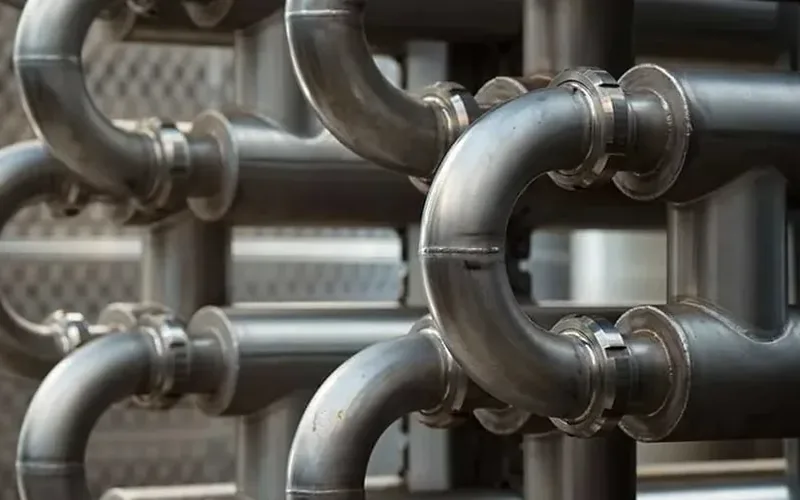
Heat Exchangers
Single Tube
Single tube heat exchanger with a full sanitary bore for dairy product carrying fruit pieces, pulp or grains, built in 316L to 3-A 12-08.
+ Learn More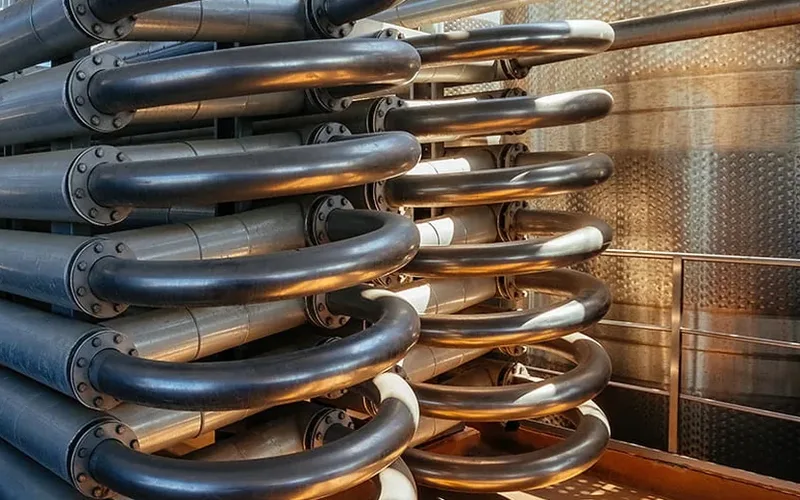
Heat Exchangers
Multi-Tube
Multi tube heat exchanger for dairy: parallel 316L product tubes in one shell for capacity on milk, cream, whey and fine-particle product.
+ Learn More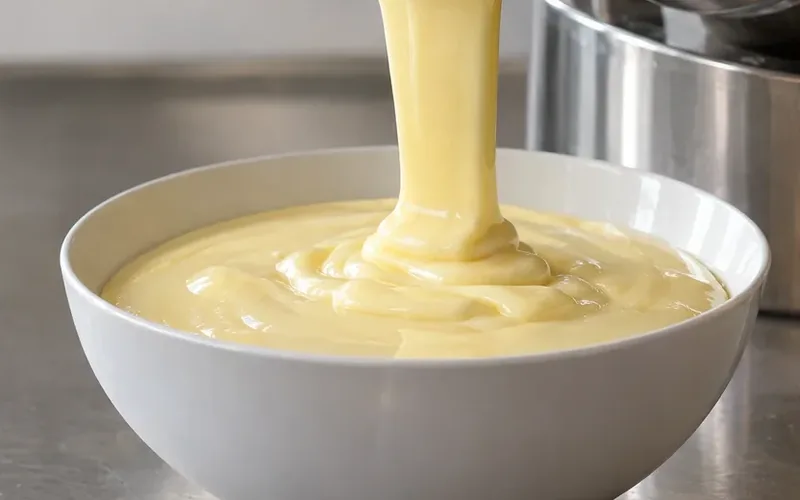
Heat Exchangers
Scraped Surface
Scraped surface heat exchanger for thick, sticky dairy product: cream cheese cold pack, process cheese, puddings and spreads that foul or set in a tube.
+ Learn More