
1-805-484-2992
Quotes - Engineering - SalesAll the heat goes through the wall
Pressurized hot water on one side, milk held liquid on the other
Indirect UHT heats milk across a stainless wall instead of mixing steam into it. The product reaches 275–300°F, holds 2–6 seconds and is cooled, and because nothing is added there is nothing to flash off: no vacuum vessel, no water balance to manage, no culinary steam quality to prove. The price is that the wall carries the entire temperature step, and every deposit on that wall shows up as a wider approach and a shorter run.
The heating medium is a closed loop of pressurized hot water, itself heated by plant steam in a separate water set. Water rather than steam on the shell keeps the tube wall only a few degrees above product, which is what slows whey protein and calcium phosphate deposit. The loop runs above its own saturation pressure, and the product side runs under enough back pressure that milk never boils in the hold.
Straight sanitary tubes in a code-stamped shell carry those pressures without a gasket in the load path. They also drain completely, take CIP at full velocity and can be inspected end to end, which is why tubular units are the usual choice for indirect UHT on milk.
See the UHT & High-Pressure Shell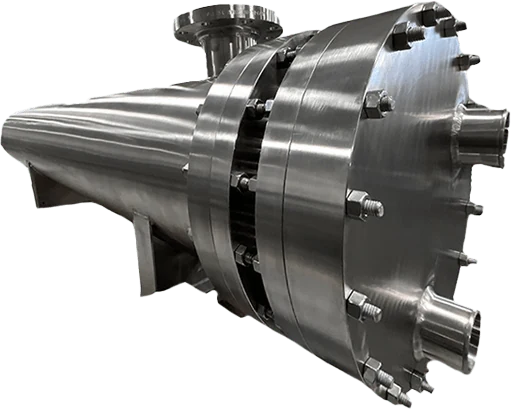
Indirect UHT heater, typical duty
These figures frame the first sizing pass. Product recipe, target run length and the plant's hot-water loop refine them.
| Condition | Typical value |
| Heating range | 275–300°F |
| Hold | 2–6 seconds |
| Heating medium | pressurized hot water, closed loop |
| Pre-hold ahead of the final heater | a short hold to stabilize whey protein |
| Regeneration | product to product, or through a water loop |
| Product-side material | 316L, 32 Ra finish |
| Shell code | ASME Section VIII above 15 psig |
| Sanitary standard | 3-A 12-08, tubular |
| Expansion | bellows or floating end on straight tubes |
Designing the heater for a long run
Where deposit starts and how to move it
Whey protein deposit builds fastest as milk crosses the range where most beta-lactoglobulin unfolds, roughly 170–230°F, and mineral scale dominates above that. Many plants insert a pre-hold: the milk is heated into that range, held briefly so the protein denatures in the bulk rather than on the wall, then taken to UHT temperature. The deposit that would have lined the final heater stays in the product.
How direct steam injection and infusion compare with this indirect route, including flavor and water balance, is covered on our direct versus indirect UHT page.
Regeneration in tubular form
A tubular UHT line recovers most of its heat by passing hot sterile product back against cold incoming milk. A direct product-to-product layout recovers the most. A layout with a water loop between the two sides gives up some recovery, but the raw and sterile streams never share a tube wall, and the loop can be trimmed to control the regenerator outlet.
- Regeneration target stated as a percent or as the heater inlet temperature
- Whether raw and sterile product may share a wall
- Where the homogenizer sits: upstream or aseptic downstream
- Cooling target after regeneration and the utility for it
Pressure, expansion and the code
Straight tubes grow as the unit heats from cleaning temperature to sterilizing temperature, and the shell grows less. A bellows on the shell or a floating tube end takes up that diffrence so the tube-to-tubesheet joints are not fatigued every run. The shell is designed and stamped to ASME Section VIII, and product-side connections are sanitary clamp fittings rated for the line's pressure.
Tube count and pass layout are chosen for velocity first. Splitting the heater into several short passes in series keeps product velocity high through the hot end, where a slow boundary layer would bake on fastest, and lets one pass be pulled for inspection without opening the whole unit.
What a UHT heater quote needs
A UHT heater is sized as much for run length as for heat duty, so the request needs more than flows and temperatures.
- Product, fat, protein and total solids
- Flow, heater inlet temperature, UHT temperature and hold
- Hot-water loop supply and return temperatures and pressure
- Run length the plant needs between cleanings
- Regeneration layout and target
Before you specify indirect UHT
Indirect heating spends longer on the way up to temperature and on the way down, so the total heat load is higher and the cooked note is usually stronger. Plants accept that for white milk because indirect avoids the culinary steam, flash vessel and water balance of direct heating. Tight approaches and short heat-up time in the tubular heater narrow the difference.
Yes, and many are. That steam-to-water set is a utility item quoted from our sister U-tube site; the product-side UHT heater, regenerator and coolers stay here. Tell us the loop temperatures and pressure so the two are sized to the same duty and the hot-water side can hold the approach the product heater needs.
As close as the tube area allows, because the wall temperature controls deposit. Tubular units run wider approaches than plate, and a heater built with a wide approach to save tube will foul first at its hot end. We set the loop temperature and the heater length together, sized for the end of the run rather than the clean start.
Not for the heater itself, where the other side is the plant's own hot-water loop and the product side can be held above loop pressure so any leak runs outward. The question matters in the regenerator, where raw and sterile product could meet through a failed joint. A water loop between them, or a double tubesheet on a product-to-product section, removes that path.
Related
Dairy Solutions
ESL Milk
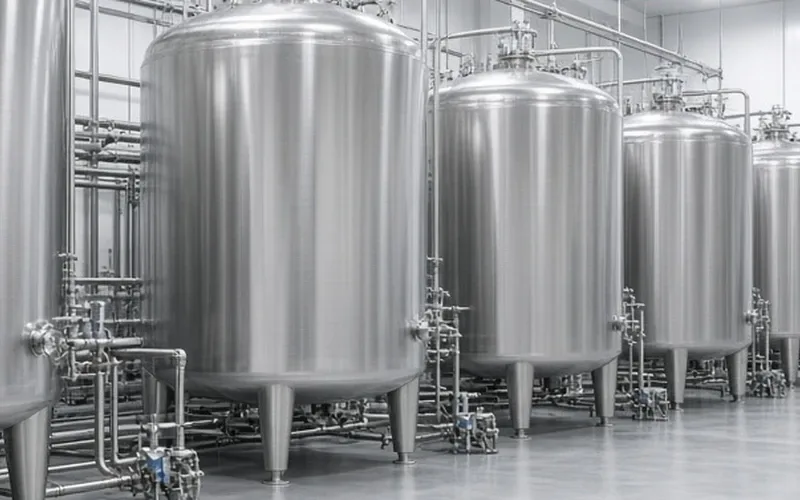
ESL milk heat exchanger for ultra-pasteurized, extended shelf life milk: tubular heating to 280°F for 2 seconds and a clean, drainable cooling path.
+ Learn More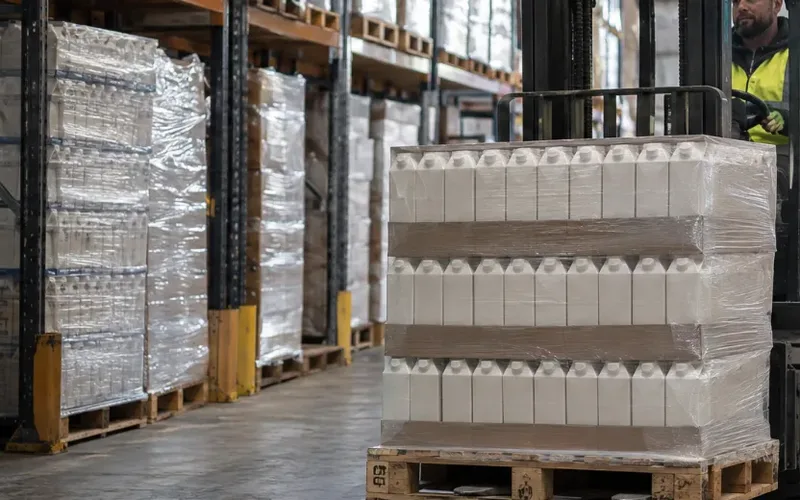
Dairy Solutions
UHT
UHT heat exchanger selection for milk: indirect tubular and shell-and-tube heating where pressure, run time and fouling rule out a plate pack.
+ Learn More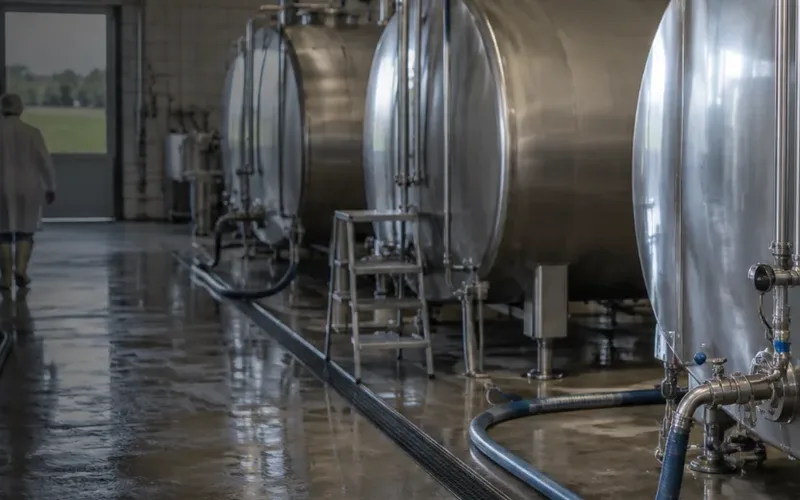
Dairy Solutions
Milk
Milk heat exchanger choices for raw milk cooling, HTST pasteurizing with regeneration, vat cooling, and white, lactose-free, recombined and condensed milk.
+ Learn More