
1-805-484-2992
Quotes - Engineering - SalesCapacity from parallel tubes, not a longer train
A multi-tube exchanger puts a bundle of smaller product tubes, often 7 or 19 of them, inside one utility shell, welded into a tube sheet at each end. The product splits across the tubes, each small enough to run turbulent at a moderate flow, and the water or glycol in the shell washes the whole bundle at once. That gives several times the surface of a single tube in the same length, which is how a tubular unit reaches plant-scale flow on milk, whey, permeate, cream and mix without a long run of hairpins.
It is the right unit when the product is smooth or carries only fine particles: fiber, cocoa, fine pulp, or soft solids of a few millimeters. Each tube is small, often around 1 in, and anything that lodges across one inlet starves that tube while the others carry on. Larger pieces need a single open bore.
Plants choose it over a plate when they want no gaskets along the product path, longer runs between cleans on a fouling stream, or a pressure rating a gasketed frame will not carry.
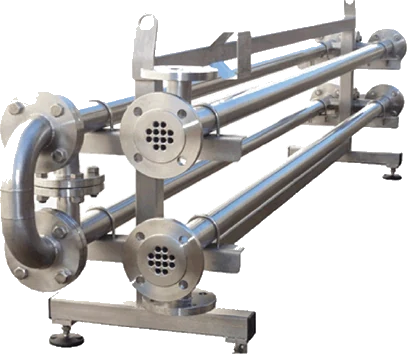
Several product tubes share one shell, so a smooth stream gets plant-scale surface in a round, gasket-free product path.
Sized for milk, whey, permeate, cream and mix.
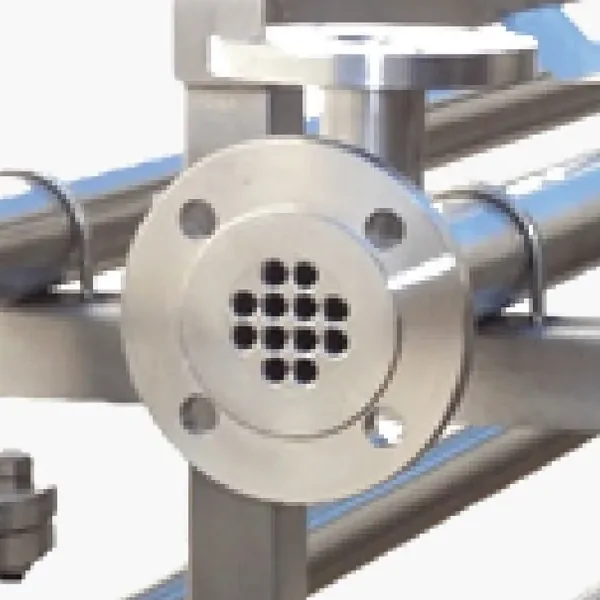
Tube sheet and inlet cone
- Inlet cone shaped to share flow across every tube
- Tubes welded to the tube sheet and ground flush
- 32 Ra tube sheet face, 20 Ra on request
- Removable cone to inspect each tube entry
- Tube count chosen so each tube runs turbulent
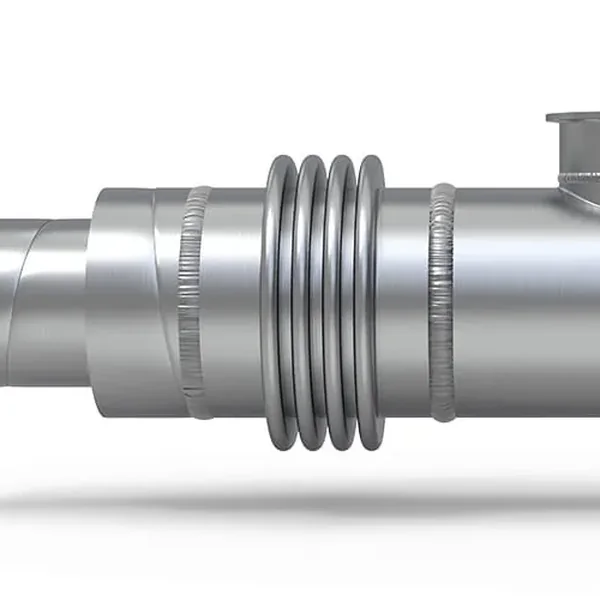
Shell and expansion
- Utility shell in 304 or 316L
- Shell bellows or a floating seal at one bundle end
- Counter-current hot water, chilled water or glycol
- ASME Section VIII shell above 15 psig
- Vent and drain on the utility side
Specify the bundle




Multi-tube standard build
Tube count and size follow from flow and allowable pressure drop. These are the defaults we start from.
| Feature | Standard build |
| Product tubes | 316L, count set by flow, often 7 or 19 |
| Tube size | Commonly around 1 in each |
| Particles passed | Fines, fibers and soft solids of a few mm |
| Product finish | 32 Ra standard; 20 Ra (about 0.5 µm) on request |
| Shell | 304 or 316L, utility side |
| Expansion | Shell bellows or floating O-ring end |
| Connections | Tri-clamp inlet and outlet cones |
| Sanitary standard | 3-A 12-08 where the symbol is expected |
| Shell code | ASME Section VIII above 15 psig |
Making parallel tubes share the load
Flow distribution
Parallel tubes only work if each one carries its share. With water-like milk that happens on its own. With a viscous cream or mix on a cooling duty, a tube that runs slightly colder runs slightly thicker, takes less flow, cools further and thickens more, and that spiral can leave one tube nearly stagnant. We guard against it with an inlet cone shaped for the product, a pressure drop per tube high enough to swamp small differences, and on thick product, fewer and larger tubes.
Thermal expansion
The tubes sit at product temperature and the shell at utility temperature, and on a heating or CIP cycle the gap between them can pass 100°F. Welded tubes in a rigid shell would load the tube-to-tube-sheet welds on every cycle, so the shell carries a bellows or one end of the bundle floats on an O-ring seal. Both work; the O-ring end goes on the maintenence list, the bellows does not.
Fouling and run length
On whey and high-protein streams a bundle tends to run longer between cleans than a tight plate pack, because a thin deposit in a round tube does not choke the passage the way it closes a 3 mm channel. It still fouls, and the heating end fouls first. Allow for a pressure drop that rises across the run, and size the product pump with margin for it.
Permeate is the easy case: lactose-rich, low in protein and close to water, it barely fouls and runs a bundle at its best approach.
Where a bundle is the wrong unit
A bundle is the capacity choice for smooth streams, and it goes wrong in a few predictable places.
- Pieces larger than a few millimeters: a single open bore
- Broken cultured product: a corrugated tube
- Water-like milk with a tight approach: a gasketed plate
- A plant that must brush every bore: straight tube and shell
Multi-tube questions
Pull the inlet and outlet cones and look down each tube against a light; a borescope reaches the middle of long tubes. The tube that fouled hardest during the run is the one most likely to come out of CIP dirty, so start at the heating end. Swabs from the tube sheet face and the cone are the usual sign-off for the record.
The tube count has to stay low enough that each tube still runs turbulent, so very small flows end up with only a few tubes per shell and behave like a single tube. Below a few thousand lb/h on milk, a plate frame or a single tube is usually the better buy. Send your flow range, including the minimum you run on reduced-rate days.
It will, with fewer and larger tubes and an inlet cone shaped for the thicker product, so cold cream does not starve one tube. Heavy cream at 36–40% fat thickens steeply on the cooling end. If it must leave at 40°F or colder, we check the outlet viscosity before choosing between a bundle and a wide-gap plate.
Yes, when the shell is sound and its drawing or measured dimensions are available; otherwise a complete new unit is quicker than matching both. We need the tube count, tube size and length, tube sheet diameter and nozzle positions. We do not re-tube a customer's bundle, so the new one arrives built and tested, ready to slide in.
Related
Heat Exchangers
Single Tube
Single tube heat exchanger with a full sanitary bore for dairy product carrying fruit pieces, pulp or grains, built in 316L to 3-A 12-08.
+ Learn More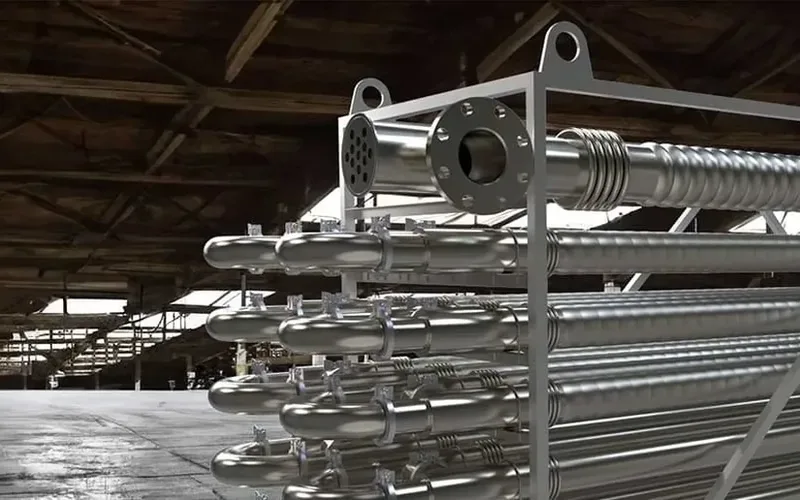
Heat Exchangers
Corrugated Tube
Corrugated tube heat exchanger for viscous and cultured dairy product: low-shear cooling of stirred yogurt, sour cream and kefir after the break.
+ Learn More
Heat Exchangers
Scraped Surface
Scraped surface heat exchanger for thick, sticky dairy product: cream cheese cold pack, process cheese, puddings and spreads that foul or set in a tube.
+ Learn More