
1-805-484-2992
Quotes - Engineering - SalesThree scopes, three different quotes
Every replacement request lands in one of three scopes. A complete new exchanger replaces the frame or shell and everything in it. A new plate pack goes into a frame you already own and keep. A new tube bundle slides into a sanitary shell that stays bolted to the floor. The right one depends less on what failed than on whether the duty the exchanger was bought for is still the duty it runs today.
New parts only
Whichever scope fits, what we supply is new: new plates, new gaskets, new bundles, new units. We do not take in a customer-owned pack to regasket, re-plate or repair it, and we do not refurbish used frames. Where the plates are sound and only the gaskets are tired, we supply new gaskets for your crew or contractor to fit.
The questions below are the ones we ask to decide which scope to quote. Answer them from the plant floor rather than the purchase file, because frames get modified over the years and the drawing in the cabinet is often out of date.
Questions that decide the scope
- Has the flow, product or temperature program changed since the unit was bought?
- Is the frame or shell free of corrosion, cracks and bent tie bars?
- Does the carrying bar have room for more plates?
- Does the inspector now expect a 3-A symbol the old unit never had?
- Do you need a section the frame does not have, such as more regeneration?
- How long can the line be down for the change?
regeneration that may outgrow the frameRaising regeneration toward 90% usually adds more plates than an old frame's carrying bar will hold, which turns a pack order into a new unit.
What each scope includes
Read this alongside the quote so the line items make sense when they arrive.
- Complete unit: frame or shell, plates or tubes, gaskets, connections, nameplate and documents
- Plate pack: new gasketed plates matched to your arrangement, with a hanging list for your crew
- Gaskets only: new gaskets for plates you are keeping, in the elastomer the duty needs
- Tube bundle: new tubes and tubesheets built to the shell's bore, length and nozzle positions
- In no scope: removal, installation, regasketing of your plates, or repair
Call and talk it through with an engineer: 1-805-484-2992
How the choice usually plays out
A plate pack makes sense when the frame is sound and the duty has not moved. Plates pit and crack over years of caustic and acid washes, gaskets take a set and start to weep at the corners, and a pack swap restores the original performance in the original frame. It is usually the lowest-cost scope by a wide margin, and the change fits inside a normal maintenance shutdown.
A new unit becomes the better buy once the duty has grown. A plant that has added a filler or raised pasteurizer throughput by a third may find the frame cannot take the extra plates the new flow needs. The same happens when the plant wants regeneration raised toward 90% to cut steam use: the regenerator lengthens, and an old frame often runs out of carrying bar before the pack is long enough.
Tubular equipment follows similar logic. A sanitary shell-and-tube with a removable bundle can take a new bundle when the shell, heads and nozzles are in good order. Tube-in-tube units are generally welded assemblies, so the replacement is a new section or a complete new unit matched to the old footprint and connections; see tube bundles and unit swap.
Code and standards status can decide it outright. An exchanger that was never built to 3-A on a line where the inspector now expects the symbol, or one who's utility shell runs above 15 psig without an ASME Section VIII stamp, may not satisfy an inspector even with new plates in it. In that case a pack is money spent on a frame that still fails the audit.
When the answer is not obvious, ask us to quote two scopes side by side. Seeing the pack price next to the complete-unit price, with the shutdown each one needs, usually settles it in one meeting.
Decide scope by the duty the line runs today, not the part that failed
A two-scope quote costs nothing extra and often saves a second round of questions.
Request a QuoteUnit, pack or bundle questions
Yes. A heater, regenerator or cooler section can be renewed on its own if the other sections are in good order. We need the plate count and arrangement for that section, the connector plates either side of it, and the frame nameplate. Mixing new and old plates inside one section is not something we recommend, because the worn plates set the performance.
No. We supply new plates and new gaskets; the fitting is done by your maintenance crew or the contractor you already use. We do not take in customer-owned plates for regasketing, re-plating or repair. New plates come with a hanging list so the pack goes back together in the right order and orientation.
It depends on the frame and the duty, so we will not quote a ratio here. What usually narrows the gap is labor and downtime: a complete unit can be built and tested before the shutdown and dropped in, while a pack swap means stripping and rebuilding the frame in place. Ask for both prices and compare the total shutdown cost.
Usually. We match connection size, type and centerline positions to the old unit where the new duty allows it, so the product and utility piping reconnects without rework. Send photos with the connections in view and the dimensions between them. If the new duty needs larger ports, the quote says so and shows the change.
Related
Sizing & Selection
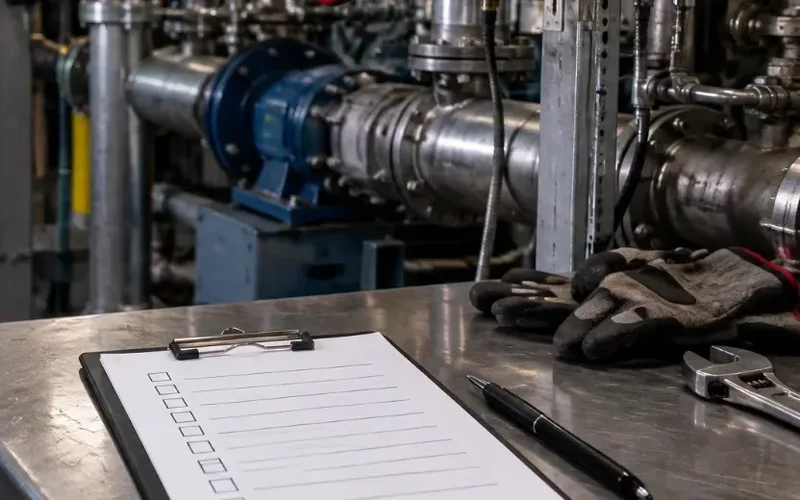
Quote Checklist
A heat exchanger quote checklist for dairy duty: each field we price from, from fat and particulates to approach and 3-A, and why each moves the price.
+ Learn More
Sizing & Selection
Ready to Quote
Prepare a dairy heat exchanger quote request that prices on the first pass: the product, duty and scope details we need, and how to send them.
+ Learn More
Sizing & Selection
Match the Product
Types of heat exchangers for dairy duty: match the product to plate, wide-gap or tube, then settle double wall and regeneration before sizing surface.
+ Learn More