
1-805-484-2992
Quotes - Engineering - SalesWhey cooling, and the streams that follow it
Ultrafiltration splits clarified whey into a protein-rich retentate and a lactose-rich permeate. The retentate, taken anywhere from WPC 34 to WPC 80 strength, is the more delicate of the two: whey proteins start to unfold and stick to hot walls once product passes about 150°F, and the deposit grows faster as solids rise.
The WPC page covers pasteurizing ahead of the membranes, holding loop temperature during filtration, and why tubes tend to outlast plates on high-solids retentate.
Permeate is mostly water, lactose and minerals, with almost no protein to foul a surface. Thermally it behaves like clean process water, so a standard gasketed plate suits it.
Its problems are mineral scale at evaporator preheat temperatures and lactose that crystallizes in the wrong place, on a cold plate rather than in the tank. The permeate page deals with both, along with cold storage after the membranes.
Whey drains from the vat at about 85–100°F carrying live culture, residual fat and curd fines. Left warm, the culture keeps making acid and the fat starts to oxidize, which costs value in every product made from it. Most plants either cool it straight to 40–45°F or pasteurize at 161°F for 15 seconds and then cool. Once separated and filtered, it becomes the two streams below.
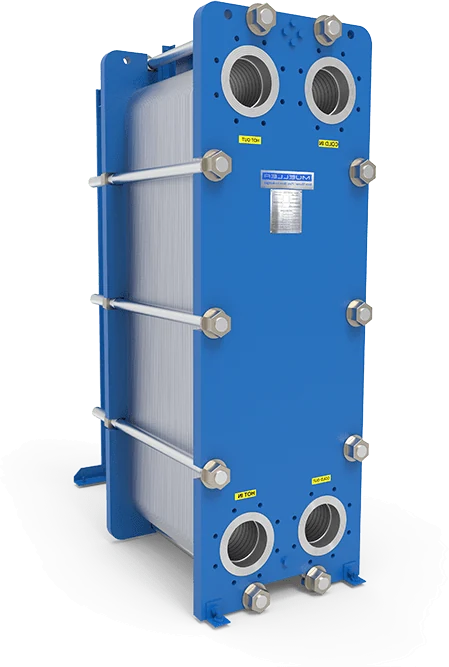
Every hour whey sits warm costs product downstream
- Cool or pasteurize whey as it drains, not after a warm silo
- Screen curd fines out ahead of a standard plate pack
- Size the cooler on peak drain rate or add a balance tank
Whey streams and the exchanger each one takes
Start from what is in the whey when it reaches the exchanger, then whether it is heated first. The construction follows from those two answers.
| WHEY STREAM | CONSTRUCTION | WHY |
| Sweet whey after fines removal, cooling only | Gasketed plate | Water-like once fines are out; plates give the closest approach on chilled water. |
| Whey still carrying curd fines | Wide-gap plate | Fines bridge a 3–5 mm channel at the inlet port; a wider gap lets them through. |
| Whey pasteurized, then cooled | Multi-section plate frame | Regenerator, heater and cooler in one frame recover most of the heat put in. |
| Acid whey from strained yogurt or cream cheese | Gasketed plate | Low solids and low pH; 316L handles it, and fast cooling stops further souring. |
| WPC retentate at high solids | Multi-tube tubular | Protein fouls narrow hot channels; tubes run longer between cleanings and take more pressure. |
Sizing a whey cooler
A whey cooler looks like the simplest exchanger in a cheese plant, and it is usually the one specified with the least data. These four inputs separate a cooler that holds its outlet from one that drifts warm every afternoon.
Where the whey comes from
Cheddar, Swiss and mozzarella vats drain sweet whey near pH 6; cottage cheese, cream cheese and strained yogurt leave acid whey nearer pH 4.5. Tell us which, and whether one cooler handles both, because the outlet target and cleaning program follow from it.
Fines and fat
- Fines saver or screen ahead of the cooler, and its mesh
- Whey separator upstream, or whey cream left in
- Any tank or silo between the vat and the cooler
- Whether the whey cream goes back to the cream line or to butter
Flow pattern
Whey arrives in surges as each vat drains, not as a steady stream. Size on the peak drain rate, or put a balance tank ahead of the cooler and size on the average. Mixing the two approaches is a common reason a whey cooler misses its outlet.
Outlet and utility
- Target outlet, usually 40–45°F
- Chilled water or glycol supply and return temperatures
- Whether whey is pasteurized at 161°F before it is cooled
Before you quote a whey cooler
When the whey, or a powder made from it, goes into Grade A products, the inspector will expect sanitary construction and usually the 3-A plate standard, 3-A 11-10. Whey headed for feed is held to a lower bar, yet most plants still buy sanitary because the cooler sits on the same cleaning circuit as the vats and the whey room is inspected with the rest of the plant.
Usually. Check the combined peak: whey drains while vats are emptying, and if raw milk receiving or a pasteurizer cooler is drawing chilled water at the same hour, supply temperature rises and both coolers miss. We size to the supply temperature you can count on at that hour of the day, not the design figure on the chiller nameplate.
Pressure drop that rises through a run, an outlet temperature that wanders, and curd packed into the inlet ports when the frame is opened. Cleaning clears it and the cycle starts again. A finer screen upstream usually ends it; where fines cannot be taken out first, a wide-gap pack passes them through without bridging.
As quickly as the line allows, because the culture keeps working until whey is below about 45°F. In practice the cooler should take whey from the drain or a small balance tank, not from a warm silo where it has already waited. Sizing for the peak drain rate is what makes that possible without a second cooler.
On a cooling-only unit there is rarely a cold stream to recover from, so no. Once whey is pasteurized first, a regenerator preheats incoming whey with outgoing hot whey just as a milk unit does, and it usually pays for itself in steam and refrigeration. The pressure differential rule then applies if the whey is destined for a Grade A product.
Related
Dairy Solutions
Whey Protein Concentrate
Whey protein concentrate processing needs gentle heat: exchangers for WPC pasteurization, UF loop temperature and retentate cooling without fouling.
+ Learn More
Dairy Solutions
Permeate
Dairy permeate processing exchangers: evaporator preheat with regeneration, scale control on the hot side, and cooling concentrate for lactose crystallizing.
+ Learn More
Dairy Solutions
Milk
Milk heat exchanger choices for raw milk cooling, HTST pasteurizing with regeneration, vat cooling, and white, lactose-free, recombined and condensed milk.
+ Learn More