
1-805-484-2992
Quotes - Engineering - SalesHow plates fail in milk service
Stainless plates in a pasteurizer rarely fail all at once. The usual story is chloride pitting under a gasket or at a contact point, a hairline crack at a port corner after years of pressure cycling, or a gasket that has taken a set and no longer seals at the groove. A pinhole of that kind is invisible in operation. In the regenerator, the pressure differential pushes pasteurized milk into raw milk through it, so the finished product stays safe while the hole quietly grows.
The danger comes later, when an upset reverses the pressures for a few seconds or the hole sits in a cooling section facing glycol. By then the first sign is often a phosphatase result or a coliform count that nobody can explain. A testing program exists to find the defect while the differential is still protecting you.
The methods below differ in three ways: whether the frame has to be opened, how small a defect they find, and how long the press stays down. Most plants use a closed-frame test on a routine interval and open the pack only when that test fails.
What a plate test program should catch
- Pinholes in regenerator plates while the differential still holds
- Cracks at port corners from repeated pressure cycling
- Crossover from glycol or hot water into product
Test methods side by side
Closed-frame tests tell you whether a section leaks. Opened-plate tests tell you which plate, and where on it.
Tests on the closed frame
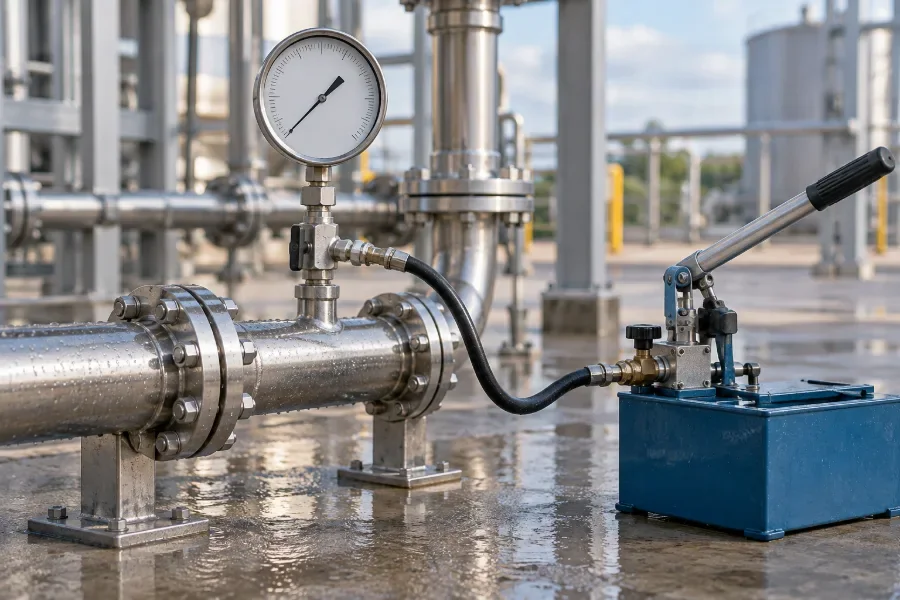
- Pressure hold: One side filled and pressurized, watch for decay or transfer
- Conductivity: Salt solution on one side, conductivity rise on the other
- Tracer gas: Hydrogen or helium mix on one side, sniffer on the other
- Best for: Routine checks without pulling plates
Tests on opened plates
- Dye penetrant: Dye on one face, developer shows the crack on the back
- Visual: Port corners, contact points and gasket grooves under good light
- Gasket condition: Hardness, set and cracking checked groove by groove
- Best for: Locating the defect once a closed test has failed
Running the tests and reading the results
Pressure hold and conductivity
Both are done with the press closed and each section isolated. In a pressure hold, one side is filled with water and pressurized while the other side is drained and open; a falling gauge or water at the open side means a path between them. The conductivity version circulates a salt solution on one side and plain water on the other, and a steady climb in conductivity on the water side shows crossover. Neither needs special gas or equipment beyond what most plants own, which is why they are the routine choice.
Tracer gas
A mix of 5% hydrogen in nitrogen, or a helium blend, is put on one side at low pressure and a sniffer probes the drained outlets of the other. Gas passes through openings far too small to leak water at test pressure, so this method finds defects early. It is the test to run when a liquid test is borderline or when a milk quality signal points at the press and nothing else shows.
How often plants test
The interval is set by the plant program and accepted by the regulatory agency, so it varies. Many Grade A plants test the regenerator every 6 to 12 months, and sooner when something prompts it.
- After a positive phosphatase or unexplained coliform result
- After any gasket change or plate replacement
- After a CIP upset with high chloride or acid strength
- Before restarting a press that has stood idle for a season
The double-wall leak path
A double-wall plate is two pressed sheets nested together with a space between them that vents to the plate edge. A hole in either sheet lets fluid into that space and out to atmosphere, so the failure shows as a drip on the outside of the frame instead of a crossover. Testing still matters, but it becomes a walk-around with the sections pressurized. The construction itself is described on the double-wall plate page.
Leak testing questions
We do not weld or repair plates. A plate that fails a test is replaced with a new one matched to the frame, pattern and gasket type, and plants usualy replace the plates on each side of it at the same time, since they saw the same chemistry and cycling. Send the plate count and nameplate data and we quote new plates and gaskets.
The hot end of the regenerator and the heating section see the highest temperatures and the most chloride activity, so pitting tends to show there first. Port corners in any section crack from pressure cycling. A cooling section on glycol deserves its own test, because a leak there carries glycol into finished product rather than raw milk.
It means no path was found at the sensitivity of that test on that day. A pinhole too small to pass water may still pass gas, and a crack can open under heat that was closed at ambient. That is why a tracer gas check follows any milk quality signal, even if the routine test passed recently.
They need it less often, but they need it. A tubular unit has welded joints and far fewer gaskets between product and utility, so the failure modes are weld cracks and pitting rather than gasket set. A pressure hold on each side is the usual method, with the interval written into the same plant program.
Take the section out of service, open the pack and use dye penetrant to find the plate. Replace it and its neighbors, fit new gaskets where the old ones have taken a set, then rerun the closed test before restart. Record the result and notify the regulatory agency as the plant program requires.
Related
Materials & Certifications
Pressure Differential
PMO pressure differential regenerator rule: pasteurized milk held at least 1 psi above raw, with booster pump and differential controls in outline.
+ Learn More
Materials & Certifications
PMO & Grade A
PMO heat exchanger requirements for Grade A dairies: what the ordinance asks of plates, regenerators, gaskets and drainage before an inspector signs off.
+ Learn More
Materials & Certifications
3-A Sanitary
3-A sanitary standards for dairy heat exchangers: the plate and tubular standards, the symbol and its third-party check, and what 3-A leaves to other rules.
+ Learn More