
1-805-484-2992
Quotes - Engineering - SalesA water-like stream with a sugar problem
Low protein, high lactose
Ultrafiltration holds back nearly all the protein and fat, so whey permeate leaves the membranes at about 5–6 percent solids, most of it lactose with the whey minerals alongside. It is as thin as water and carries almost nothing that bakes onto a hot wall the way milk protein does. A standard gasketed plate with a 3–5 mm channel suits it, runs close approaches and recovers heat well, which matters on a stream that is heated and cooled in large volumes for little value per pound.
The trouble comes from the two things permeate does carry. Calcium phosphate in solution becomes less soluble as temperature rises, so the preheater ahead of an evaporator scales on its hottest plates. Lactose works the other way: concentrated permeate is supersaturated once it cools, and crystals start wherever the surface is coldest, which can be the cooler plate rather than the crystallizer tank where the plant wants them.
There is also the biology. Permeate is a sugar solution with minerals, an easy medium for growth, so it should be held either hot or cold, never warm in between.
See the Gasketed Plate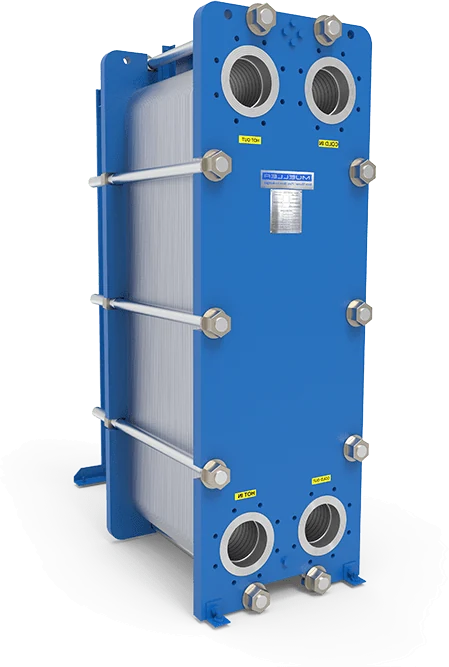
Permeate stream values
Ranges seen on whey permeate lines feeding an evaporator and a lactose crystallizer. Your evaporator design figures override them.
| Condition | Typical value |
| Permeate solids from UF | About 5–6%, mostly lactose |
| Protein | Low; little protein fouling on hot walls |
| Cold storage | 40–45°F |
| Preheat source | Evaporator condensate or hot concentrate, then hot water |
| Hot-side concern | Calcium phosphate scale on the hottest plates |
| Concentrate solids | About 55–65% leaving the evaporator |
| Concentrate cooling | Tempered water, controlled rate, no cold spots |
| Plate channel | 3–5 mm standard; wider on concentrate |
| Product-side build | 316L, tri-clamp, 32 Ra, EPDM gaskets |
Where exchangers sit on a permeate line
Cold storage after the membranes
Permeate coming off a warm filtration loop goes to storage, and if it will wait more than a short while it is cooled to 40–45°F on the way. This is the simplest duty on the line: thin product, chilled water, a close approach and a small plate pack.
- Size for the warmest permeate the filtration loop delivers
- Send the storage time, which decides whether cooling is needed at all
- Note whether the same pack also cools RO water recovered from permeate
Preheating the evaporator feed
An evaporator wants its feed hot, and heating thin permeate from storage temperature is a large energy bill unless most of it is recovered. A multi-section frame can take heat from evaporator condensate in one section and finish on hot water in the next, both in one frame.
- Send the condensate flow and temperature with the permeate data
- Tell us the evaporator's required feed temperature
- Note any acid or demineralizing step ahead of the evaporator
Keeping scale off the hot plates
Calcium phosphate drops out on the hottest surfaces first, so the final heating section is where scale shows. A modest approach at the outlet keeps the wall temperature down, and an acid wash in the cleaning program removes what does form. Plants that demineralize permeate before the evaporator see far less of it.
Cooling concentrate toward crystallization
Concentrate leaving the evaporator at 55–65 percent solids is cooled to start lactose crystallizing, and the rate matters as much as the end point. A cold wall nucleates fine crystals on the plate, which foul it and give a poor crystal size later. A wide-channel cooler on tempered water, with the approach kept small, brings the concentrate down without that cold spot, and the crystallizer tank does the slow work from there. Its protein-rich counterpart is covered under whey protein concentrate.
Permeate questions
They can, as separate sections in one frame, when both duties run at the same time. Warm permeate headed for storage can give it's heat to cold stored permeate headed for the evaporator before chilled water and hot water finish each side. If storage filling and evaporation run on different shifts, that recovery never happens, and two small frames are simpler to schedule and clean.
Either works if it is not left warm. Cold holding at 40–45°F suits a plant that stores permeate for hours and fills the evaporator in campaigns; the cost is reheating it all. Hot holding saves that energy but needs a short, steady path to the evaporator and a temperature high enough to stop growth. The exchanger layout follows whichever the plant chooses.
Permeate runs hotter at that point, and with the protein gone there is nothing to hold calcium phosphate in solution the way whey proteins partly do in whole whey. The mineral comes out on the hottest plates. A smaller outlet approach, a regular acid step in the cleaning and, where the plant does it, demineralizing upstream all reduce the scale.
Only with care. A large gap between chilled water and supersaturated concentrate makes the plate the coldest point in the system, and crystals start there instead of in the tank. The result is a fouled cooler and finer crystals that are harder to separate. Tempered water with a small approach gets most of the cooling without that risk.
Rarely. Permeate is a processing stream, and the usual concern is keeping cooling water out of it rather than separating raw from pasteurized product. A standard gasketed pack with leak-detection ports between gaskets, cleaned and pressure tested on schedule, covers most plants. Double wall is worth discussing only when the utility side carries something the product must never see.
Related
Dairy Solutions
Whey Protein Concentrate
Whey protein concentrate processing needs gentle heat: exchangers for WPC pasteurization, UF loop temperature and retentate cooling without fouling.
+ Learn More
Dairy Solutions
Whey & Permeate
Whey cooler sizing for cheese plants: cooling sweet or acid whey to 40–45°F, whey pasteurizing, and exchangers for WPC and permeate streams.
+ Learn More
Dairy Solutions
Milk
Milk heat exchanger choices for raw milk cooling, HTST pasteurizing with regeneration, vat cooling, and white, lactose-free, recombined and condensed milk.
+ Learn More