
1-805-484-2992
Quotes - Engineering - SalesSanitary means it cleans, drains and can be seen
A sanitary dairy exchanger is one that a CIP circuit can clean without anyone taking it apart, that empties itself when the circuit stops, and that an inspector can open and examine when there is reason to. Material, finish, connections and drainage are the four tools a designer has to get there, and each is easy to compromise to save money on a single line of a quotation.
On our units the product side is 316L stainless, finished to 32 Ra or smoother, with tri-clamp connections and a layout that drains. Gaskets and O-rings are chosen by the product's fat content and the plant's wash chemistry, and every product-contact compound complies with FDA 21 CFR 177.2600. Where an audit asks for 20 Ra, we finish to 20 Ra and record the readings.
The utility side is held to a different test. Hot water, chilled water, propylene glycol and steam-heated water do not need a polished surface, but they do need to stay on their own side of the wall. That is why the sanitary rules stop at the product boundary while pressure ratings, leak paths and code stamps carry on beyond it.
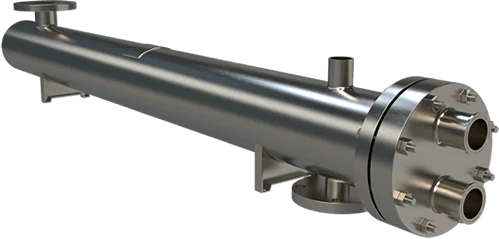
Product side
- 316L finished to 32 Ra or better
- Tri-clamp ends, self-draining layout
- Washed in place after every run
Utility side
- Alloy chosen for the water chemistry
- Flanged or threaded where allowed
- Cleaned when scale or fouling shows
Four parts of a sanitary product side
Each of these has its own page with the figures and the usual mistakes. In short, this is what each one has to achieve on a dairy exchanger before the other three can do their job.
316L stainless
- Low carbon, so welds keep corrosion resistance
- Molybdenum against chloride pitting
- Mill certificates traced to each heat
Elastomers
- EPDM for hot water, steam and CIP chemistry
- NBR where cream fat would swell EPDM
- HNBR where one compound must do both
Surface finish
- 32 Ra, about 0.8 µm, as standard
- 20 Ra, about 0.5 µm, when audited
- Welds and ports finished to the same number
Connections and drainage
- Tri-clamp ferrules on every product port
- No dead leg a wash cannot reach
- A fall to the drain, or vertical mounting
Where sanitary design slips in service
Most of the failures we are asked about are not in the exchanger but at its edges: a thermometer tee that leaves a two-inch dead leg, a reducer installed so it traps a pocket of water, a horizontal tubular stack set level on a skid nobody shimmed. Each one holds product or rinse water, and each one shows up first as a swab or plate count rather than as a visible leak.
The exchanger can be built perfectly and still be blamed for those counts, so it is worth looking at the piping around it when QA raises a flag.
Plate and tube fail in different places
A plate pack loses its sanitary condition at the gasket: a swollen, extruded or cracked seal opens a crevice the wash cannot reach. A tubular unit loses it at a weld or at the seal of a removable bend. Knowing which construction you run tells you where to look first when a count rises, and which spare parts to keep on the shelf.
What sanitary design cannot fix
A sanitary exchanger run outside its design still fouls. Burn-on in a cream heater driven with too wide a temperature difference, or protein deposit in a regenerator run below its design velocity, is a sizing problem rather than a design flaw. The utility and approach guide covers that side of the question, and it belongs in the same conversation.
Put it on the request
Tell us the finish your audit names, the gasket compound the plant keeps in stock, the clamp size the plant standardizes on, and how the unit will sit on its skid or stand. Those four facts settle most of the sanitary detail before a drawing is made, and they keep the drawing from coming back for a second round of comments.
Sanitary design questions
304 is used in some dairy equipment, but we build the product side of our exchangers in 316L. Heat transfer surfaces are thin, run hot, see chlorinated water and sanitizers everyday, and a pit through a plate is a pinhole between two streams. The molybdenum in 316L buys pitting resistance that matters on a wall that thin.
A dead leg is any branch off the product path that the cleaning flow does not sweep: a capped tee, an instrument port, a valve body set too far off the line. A common design target is a branch no longer than about two pipe diameters. We keep instrument connections on the exchanger close-coupled for that reason.
Not routinely. It is designed to clean in place, and opening it is for inspection, gasket or seal change and the leak tests the plant's program calls for. Brush-clean straight-tube units are the deliberate exception, chosen where the plant wants a mechanical clean of each tube between runs.
No. The polished finish, sanitary fittings and drainability are product-side requirements. The utility side has to hold its pressure, resist its own water chemistry and stay separated from product. On a plate unit both sides are the same pressed sheet, so the utility channels happen to be 316L too; on a tubular unit the outer tube or shell is chosen for the utility.
Related
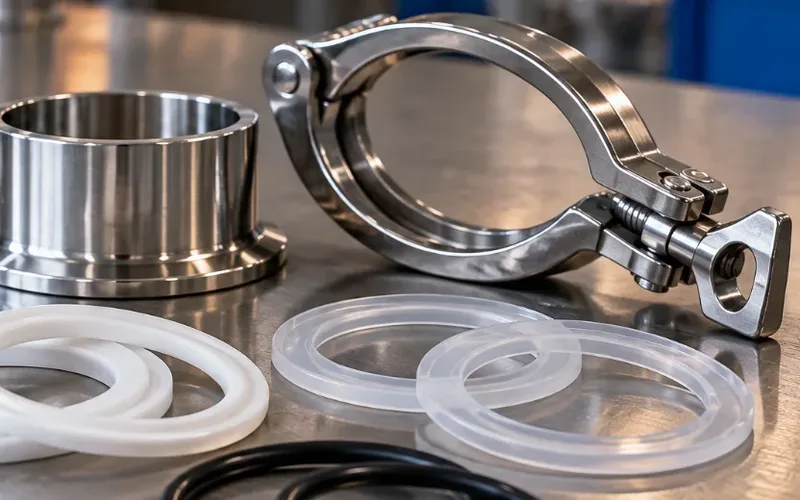
Materials & Certifications
316L & Elastomers
Why a 316L dairy heat exchanger, and how EPDM, NBR and HNBR gaskets are matched to product fat, wash chemistry and heat. FDA-compliant compounds only.
+ Learn More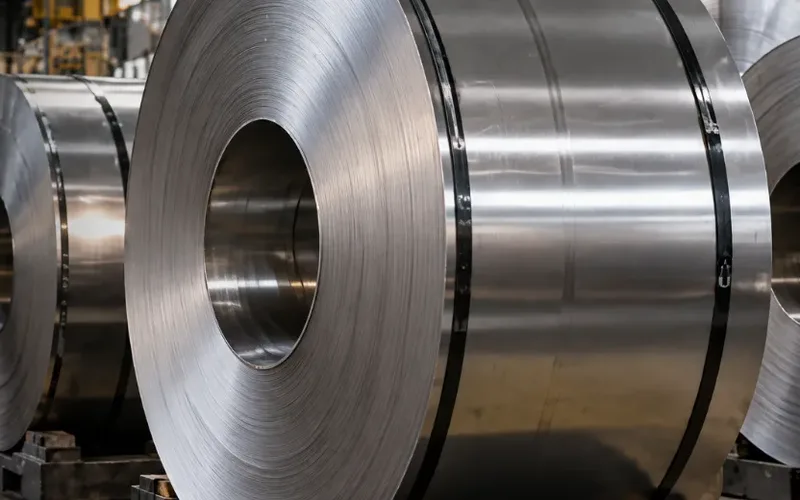
Materials & Certifications
32 Ra or 20 Ra Finish
A 32 Ra surface finish is the dairy heat exchanger standard, and 20 Ra goes on when the audit asks. Where finish is measured, where it slips, what it adds.
+ Learn More
Materials & Certifications
Tri-Clamp & Drainability
A tri clamp heat exchanger for dairy must connect, drain and clean in place on its own. Ferrules, clamp gaskets, drain fall and CIP velocity explained.
+ Learn More