
1-805-484-2992
Quotes - Engineering - SalesA cheese made from three streams
Skim milk, wash water and dressing each need their own exchanger
Cottage cheese is a skim milk curd that is cooked, washed and then coated in a cream dressing. Each of those steps puts a different stream through a heat exchanger, and each has its own rule.
Skim milk is pasteurized at 161°F for at least 15 seconds and brought to setting temperature, often in the mid 80s. The curd is cooked in the vat, then washed in water that steps down from about 86–90°F to near 57°F and finally to about 39°F, which firms the curd and stops the culture. The dressing is pasteurized at 150°F for 30 minutes or 166°F for 15 seconds and cooled to 40°F or lower before it meets the curd.
That gives a plant three exchangers: a skim pasteurizer with a warm outlet, a wash water chiller, and a dressing heater and cooler. The dressing is the one most often sized wrong, because cream and stabilizers make it thicker than the milk the plant is used to, so it goes to a wide-gap plate rather than a standard pack.
See the Wide-Gap Plate
Typical cottage cheese duties
These are starting figures. Setting temperature, wash steps and dressing fat vary by plant and by large or small curd, so send the make sheet with the request.
| Stream | Typical duty |
| Skim milk pasteurizing | 161°F for at least 15 seconds |
| Skim milk to the vat | setting temperature, often in the mid 80s |
| Curd cook in the vat | up to about 131°F by curd type |
| First wash water | about 86–90°F |
| Second and final wash | near 57°F, then about 39°F |
| Dressing, vat | 150°F for 30 minutes |
| Dressing, continuous | 166°F for 15 seconds |
| Dressing after pasteurizing | 40°F or lower |
| Gaskets | EPDM on skim and water; NBR on dressing |
Sizing each stream
Skim milk with a warm outlet
The skim pasteurizer looks like a cheese milk frame. Its outlet goes to the vat at setting temperature, not to cold storage, so regeneration tops out earlier than on a bottling line and a trim section on tempered water holds the outlet. If more than two hours pass between pasteurizing and setting, the skim has to be cooled and held at 45°F or lower until it is set, which turns the trim section into a full cooler. The layout is set out on our cheese milk page.
Wash water is a chilling duty
Wash water is potable water treated to the plant's own program, and the final wash has to be cold enough to firm the curd without freezing it onto the vat wall. A plate chiller on glycol or chilled water takes city or well water from 55–70°F down to the high 30s at the flow the wash schedule needs. Because each wash is a batch, the chiller is often paired with a cold water tank so it can run steadily between washes.
- Water volume per wash and the amount of washes per vat
- Inlet water temperature in the hottest month
- Final wash temperature the curd needs
- Whether wash water is pasteurized, chlorinated or acidified
Dressing is the thick one
Cream dressing carries milkfat, salt and often a stabilizer, and it thickens sharply as it cools toward 40°F. On a standard 3–5 mm plate the cold end loses velocity and the pressure drop climbs. A wide-gap channel, or a tubular cooler on heavier dressings, keeps the cooling section moving. Plants that batch dressing in a vat use the plate only as a cooler; plants on a continuous line run heating, hold and cooling through one frame, as covered for vat pasteurizer cooling.
Send the dressing recipe range with the request: fat, salt, stabilizer and the coldest temperature it must reach. A dressing that runs well at 45°F can stall a narrow channel at 38°F.
Cottage cheese questions
Not well. Skim runs at 161°F to a warm outlet; dressing runs at 166°F to 40°F or lower, and it is thicker and higher in fat. One frame swinging between them needs different gaskets, a different channel and a different outlet. Most plants run two units, or batch the dressing in a vat and keep a separate cooler for it.
Most make sheets bring the final wash near 39°F, which firms the curd and slows the culture before creaming. Colder water risks freezing curd on the vat wall. We size the chiller to your final wash temperature and the volume per wash, and we note the glycol supply temperature needed to hold that approach in summer.
Usually. Dressing fat swells EPDM over time, and NBR or HNBR holds its shape in milkfat while still standing up to the cleaning cycle. Skim milk and wash water stay on EPDM. Tell us the dressing fat percentage and the wash chemistry, and the compound is matched to both rather than to the milk side alone.
No. We supply the heat exchangers on the three streams: skim milk, wash water and dressing. The vat, its controls and the curd handling stay with the plant's existing equipment. The quote shows where each exchanger connects and the flows and temperatures it was sized for, so the vat supplier and the plant can check the fit.
Related
Dairy Solutions
Cheese Milk
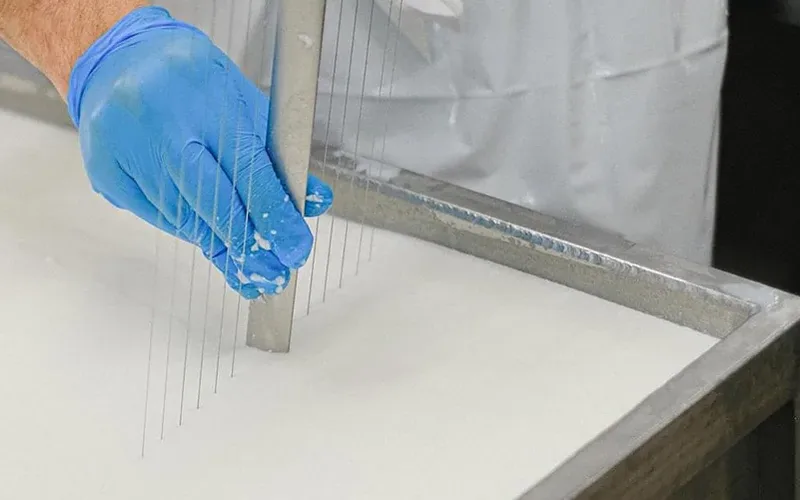
Cheese milk heat exchanger for pasteurizing or thermizing, then trimming the milk to vat set temperature. Plate frame sizing, regeneration and outlet control.
+ Learn More
Dairy Solutions
Yogurt & Cultured Product
Tube in tube yogurt cooling after the break, plus plate heating of the milk base to 185–195°F and cooling to incubation temperature.
+ Learn More
Dairy Solutions
Sour Cream
Sour cream processing heat exchangers: NBR-gasketed plate to pasteurize the cream and reach culture temperature, tubular cooling once it has cultured.
+ Learn More