
1-805-484-2992
Quotes - Engineering - SalesFat standardization and the exchanger loop
Separator and homogenizer positions
A white milk line makes four products from one raw silo: skim under 0.5 percent fat, 1 percent lowfat, 2 percent reduced fat and whole milk at about 3.25 percent. A separator and a standardizing system take the fat out and meter the right amount back, and most plants do it warm, in the middle of the regeneration section. Raw milk leaves the first regenerator stage at roughly 100–130°F, passes through the separator, and returns to the second stage with the cream trimmed to target.
The homogenizer comes next. It wants warm milk, usually 130°F and up, so the fat is fully liquid and the globules shear down cleanly at 2,000–2,500 psi. That places it after the regenerator and ahead of the heater, and on many lines it doubles as the timing pump. Separator and homogenizer each need a take-off and a return port in the frame, so the regenerator is split into stages with connector plates between them. When we lay out a white milk frame, those two temperatures fix the stage split before plate count is even considered.
See the Multi-Section Frames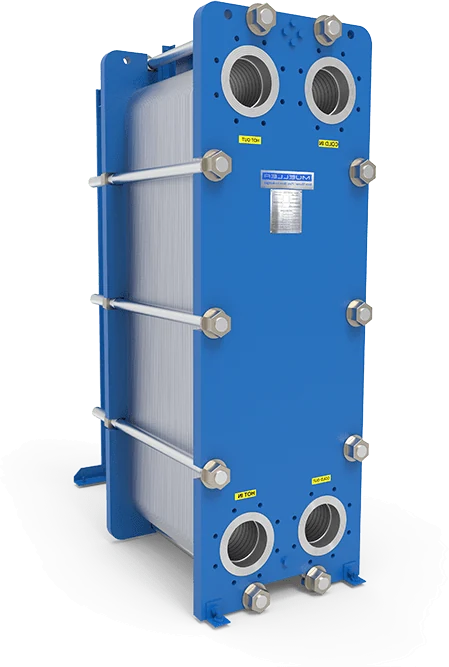
White milk HTST design points
Typical figures for a fluid milk plant standardizing in line. The separator supplier's inlet temperature and the homogenizer's rating take priority where they differ.
| Condition | Typical value |
| Skim milk fat | under 0.5% |
| Lowfat and reduced fat | 1% and 2%, standardized in line |
| Whole milk fat | about 3.25% |
| Warm separation | 100–130°F between regenerator stages |
| Homogenizer inlet | 130–160°F |
| Homogenizing pressure | 2,000–2,500 psi, two stage |
| Pasteurizing | 161°F for 15 seconds |
| Milk to filler | 36–40°F |
What changes across the four milks, and what does not
The plates barely notice the fat
Between skim and whole milk, viscosity at pasteurizing temperature changes little and film coefficients stay within a few percent of each other. A frame sized for whole milk runs skim at the same flow with slightly less pressure drop. Plants that try to buy a separate exchanger for each fat level pay for plates they will never use; the money is better spent on heater area for run length.
- Size heater area on run length, not on fat level
- Check pressure drop at whole milk and the coldest raw milk temperature
- Expect the same plate count for skim, lowfat, reduced fat and whole
The separator sets the stage split
Warm separation pulls cream off at 35–45 percent fat and sends skim back into the second regenerator stage. If the plant also sells cream from the same separator, that cream leaves the loop warm and needs its own cooler, usually wide-gap plate or tubular because high-fat cream thickens as it cools. That cooler is a separate exchanger, sized as set out under cream heating and cooling.
Homogenizer flow and the timing pump
When the homogenizer is the timing pump, its capacity sets flow through the whole frame and the holding tube. A homogenizer recycling part of its output changes the pressures in the regenerator, so the 1 psi differential has to be proved at every flow the line will actually run, not only at nameplate rate.
- Tell us wether the homogenizer is the timing pump or sits downstream of one
- Give the inlet temperature the homogenizer supplier asks for
- Note any bypass or recycle that runs at partial flow
Changeovers between fat levels
Every switch from skim to whole pushes a slug of mixed product through the frame. The volume held in the plate pack, holding tube and piping decides how many gallons land in neither specification, and a long, high-regeneration frame holds more milk than a short one. Plants that change fat level several times a shift often accept slightly lower regeneration to keep hold-up volume down, and run from lowest to highest fat so the intermix can be reworked into the next product.
What QA asks about fluid milk
Skim carries the same proteins and minerals as whole milk at nearly the same concentration, so heater fouling is much the same. Run length depends more on raw milk quality, its age and acidity, and how hot the heating water runs against the plate wall. QA usually gains more run time by tightening raw milk acceptance than by changing the plate pack.
Yes, with a cold-milk separator, which has to be larger for the same flow because fat separates more slowly from cold milk. Cold standardization removes the warm take-off from the regenerator, so the frame can run as one regenerator stage with fewer connector plates. The trade is separator size and cost; the exchanger itself gets simpler and shorter.
Ahead of the heater, on raw milk after regeneration, is the usual choice for HTST fluid milk because the holding tube then pasteurizes everything the homogenizer touched. Homogenizing after the holding tube puts a piston pump and valve seats on the pasteurized side, which aseptic and some ESL lines accept but which adds sanitation work on an ordinary HTST line.
No. Milk under 10 percent fat without added sweeteners pasteurizes at 161°F for 15 seconds, the same as skim and whole. Most plants run a degree or two above that for margin at the recording thermometer. Flavored milks with added sugar move to 166°F, and that is the case that sizes the heater when they share the frame.
Vitamin A and D concentrates are normally dosed before pasteurization so the holding tube treats the added stream along with the milk. Dosing ahead of the regenerator or into the standardized milk at the separator outlet both work for the exchanger, which sees no measurable change in duty. What matters is that the dosing point does not add an unpasteurized connection on the pasteurized side of the frame.
Related
Dairy Solutions
Raw Milk Cooling
A raw milk cooler on the plant receiving line takes tanker milk to 36–40°F before the silo. Plate sizing, chilled water or glycol, and 3-A build.
+ Learn More
Dairy Solutions
HTST & Regeneration
An HTST plate heat exchanger puts regenerator, heater and cooler in one frame. How regeneration percent, the 1 psi rule and the section layout are sized.
+ Learn More
Dairy Solutions
Lactose-Free Milk
Lactose-free milk processing adds lactase hydrolysis, a sweeter product and faster browning at heat. How that changes the heater, construction and run time.
+ Learn More