
1-805-484-2992
Quotes - Engineering - SalesWhat lactase does to the heating duty
Two reducing sugars where there was one
Lactose-free milk starts as ordinary milk with lactase enzyme added. The enzyme splits each lactose molecule into glucose and galactose, and the hydrolysis runs either cold in a tank, around 40°F for about a day, or warm for a few hours in the 95–105°F range where many lactase enzymes work fastest. Some plants instead dose a sterile lactase after heat treatment and let hydrolysis finish in the package. Many also ultrafilter first to remove part of the lactose, which keeps the sweetness closer to regular milk.
The finished product tastes noticeably sweeter, and it behaves differently on a hot plate. Glucose and galactose are both reducing sugars, and with two of them where lactose was one, the Maillard reaction runs faster. At HTST temperature that shows as quicker fouling in the heater; at ultra-pasteurized temperatures of 280°F and above it shows as tan color, cooked flavor and deposit that cuts the run short. Because most lactose-free milk is sold with an extended shelf life, the heating duty is usually the ultra-pasteurized one, and that is where we build tubular.
See the UHT & High-Pressure Shell
Lactose-free heating conditions
Typical figures for a lactose-free line running ultra-pasteurized. An HTST lactose-free line uses the fluid milk figures with a cooler-running heater.
| Condition | Typical value |
| Cold hydrolysis | about 40°F, around 24 hours in tank |
| Warm hydrolysis | 95–105°F, a few hours |
| Ultra-pasteurizing | 280°F or above for at least 2 seconds |
| Preheat ahead of final heater | about 170–185°F |
| Heating medium | pressurized hot water |
| Product side | 316L tubes, tri-clamp, drainable |
| Cooling after the hold | 36–40°F before filling |
| Product-contact finish | 32 Ra standard, 20 Ra on request |
Running hydrolyzed milk through heat
Why the final heater sees it first
Browning and protein deposit both rise with wall temperature, and the hottest wall is in the final heater. Keeping the difference between heating water and product small, often under 10°F at the outlet of a tubular heater, slows both. It costs heat transfer area, but on a lactose-free line the extra area is cheaper than the hours lost to an early clean.
Plate or tube for lactose-free
An HTST lactose-free line with a short shelf life can stay on a gasketed plate frame, sized with a cooler-running heater and some spare area. Once the product goes to ultra-pasteurized temperature, gasket life near 280°F and run length both argue for a sanitary shell with straight product tubes, rated for the pressure the hot-water side needs to stay liquid.
- HTST with a short shelf life: gasketed plate with extra heater area
- Ultra-pasteurized with an extended shelf life: sanitary tubular shell
- Mixed lines: a tubular final heater with plate regeneration, where the plant accepts the split
Where the enzyme goes in the line
When lactase is dosed before heat treatment, pasteurizing inactivates it, so hydrolysis has to be complete before the milk reaches the heater. When sterile lactase is dosed afterward, the exchanger handles regular milk and the sweetness develops in the package. The second route keeps the heater cleaner. Either way the quote should say which sugars the product carries when it reaches the hot section, and the cooling end follows the same rules as ESL milk cooling.
Heat recovery on an ultra-pasteurized line
Tubular ultra-pasteurizing lines recover heat either product-to-product or through a closed water loop. Product-to-product recovers more, but it puts hydrolyzed milk on both sides of the tube wall, so both sides foul. A water loop recovers less, keeps the hot product side cleaner and is cleaned with the line. On lactose-free product the water loop is often the better trade, and it makes keeping treated product on the high-pressure side simpler.
Notes on lactose-free runs
It depends on heater wall temperature, the hydrolysis route and the protein level, so there is no fixed ratio. Plants that put lactose-free product on a frame sized for white milk often see the heater foul noticeably sooner. Sizing the heater for lactose-free from the start, with a closer approach and more area, recovers most of that time.
Yes, and many plants schedule it that way, but order matters. Running lactose-free product first, straight after a clean, keeps lactose from a regular milk run out of a product sold as lactose-free and puts it's faster fouling on clean plates. Plan the water push and the product-to-product interface at changeover; the exchanger only needs to drain fully and clean at the line's CIP rate.
Ultrafiltration raises protein and lowers lactose, so the product is a little thicker and carries more protein to the hot wall. Viscosity stays close to milk, and a unit sized for milk handles it, but the heater fouling allowance should reflect the higher protein. Send the protein and total solids figures along with the fat.
As deposit insulates the heater wall, the heating water is driven hotter to hold temperature at the hold tube, and the milk then meets a hotter surface for the same time. A tan cast late in the run usually means the heater has run out of margin. A closer approach backed by more area, or a clean scheduled before that point, fixes it.
Very little. Hydrolysis does not change viscosity enough to matter in a plate or tube cooler, so the cooling side is sized as for milk of the same fat. What matters on an extended shelf life product is that the cooler drains completely and is built to the same sanitary standard as the heater, since it sits downstream of the hold.
Related
Dairy Solutions
Raw Milk Cooling
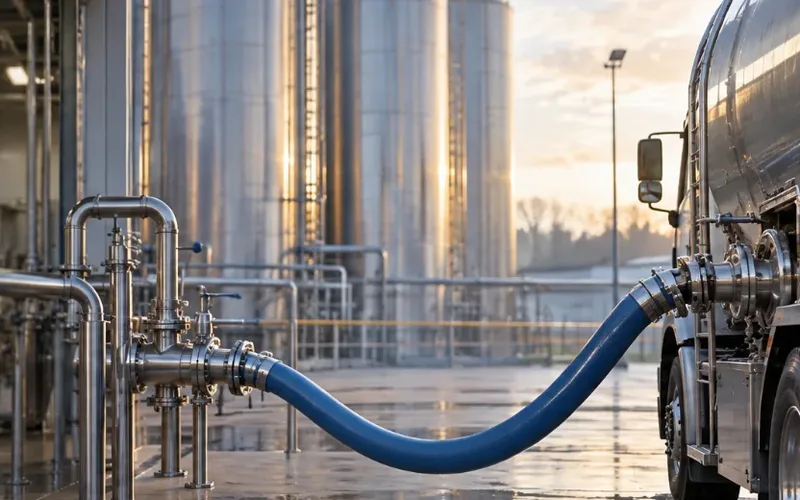
A raw milk cooler on the plant receiving line takes tanker milk to 36–40°F before the silo. Plate sizing, chilled water or glycol, and 3-A build.
+ Learn More
Dairy Solutions
HTST & Regeneration
An HTST plate heat exchanger puts regenerator, heater and cooler in one frame. How regeneration percent, the 1 psi rule and the section layout are sized.
+ Learn More
Dairy Solutions
White Milk
White milk processing runs skim, 1%, 2% and whole milk through one HTST frame. Where standardization and the homogenizer sit, and how the pack is sized.
+ Learn More