
1-805-484-2992
Quotes - Engineering - SalesBefore and after the evaporator
Two exchangers, two very different products
A condensed milk line has a heat duty on each side of the evaporator, and the two barely resemble each other. Ahead of it, standardized milk is forewarmed, often to 185–212°F with a short hold, to stabilize the proteins so the finished product resists thickening or coagulating in the can. That feed is still thin, and a gasketed plate preheater with a holding section handles it well, often with heat recovered from evaporator condensate. The hold is part of the duty, so the holding section's volume belongs in the preheater design from the start.
Behind the evaporator, the product is a concentrate. Evaporated milk leaves at 23 percent total milk solids or more; sweetened condensed milk carries at least 28 percent milk solids plus roughly 40–45 percent sugar and is far thicker. Viscosity climbs with every point of solids and climbs again as the concentrate cools, so a cooler laid out like a milk plate runs out of allowable pressure drop long before it runs out of area. That is the duty we usually build as multi-tube, with product in large straight tubes and cooling water in the shell around them.
See the Multi-Tube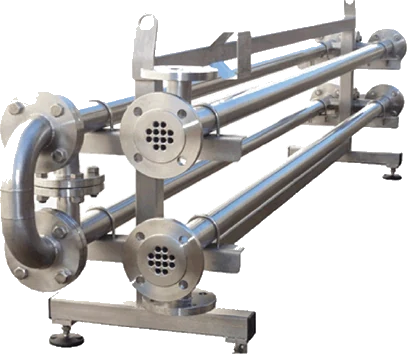
Condensed line conditions
Typical values on either side of a milk evaporator. Your product's solids, sugar and cooling target set the final figures.
| Condition | Typical value |
| Feed milk to preheater | 36–40°F from the silo |
| Forewarming | 185–212°F, short hold |
| Evaporated milk | 23% total milk solids minimum |
| Sweetened condensed milk | 28% milk solids minimum, plus sugar |
| Concentrate off the evaporator | about 115–130°F |
| Lactose seeding | about 86°F, then cooled further |
| Cooling utility | tower water, then chilled water |
| Preheater construction | gasketed plate with holding section |
| Concentrate cooler construction | multi-tube, 316L product side |
Sizing the condensed milk exchangers
The preheater is a milk duty
Feed milk on its way to the evaporator is still water-like, and forewarming is a heater with a hold, laid out much like an HTST but hotter. At 185°F and above, protein deposit on the plates builds quickly, so the preheater gets generous area, a tight hot-water approach and a run plan that matches the evaporator's own cleaning cycle. Plants that recover condensate heat into the feed often add a regeneration section to the same frame.
- Give the forewarming temperature and hold time the product specification calls for
- Say how many hours the evaporator runs between cleans
- Note any condensate or vapor heat available for recovery
The cooler is a viscosity duty
Concentrate viscosity can rise tenfold or more between the evaporator outlet and storage temperature, and sweetened condensed milk is thicker again. Tube-in-tube construction keeps the flow area large and the pressure drop manageable, accepts higher pumping pressure, and drains completely, which matters with a product this sticky. Narrow plate channels pack with concentrate when the line stops, and a restart against a packed channel pushes pressure past what gaskets tolerate.
Crystallization on sweetened condensed milk
Sweetened condensed milk is supersaturated in lactose once it cools. Plants cool it quickly to about 86°F, seed it with fine lactose so the crystals stay small, then finish cooling under agitation. The exchanger has to hold a steady outlet temperature at the seeding point, so we size it on the thickest product the line runs, with a cooling-water loop that can be trimmed close.
- Send solids and sugar for every concentrate the line makes
- Give the target temperature at the seeding point and at storage
- Say whether the cooler discharges to a crystallizer or a storage tank
Utility for the concentrate cooler
Tower water can take concentrate down to the seeding point in most climates, with chilled water or glycol finishing the trip to storage. Splitting the cooler in to a tower-water section and a chilled section saves refrigeration, but the cold section sees the thickest product, so its tube count is set by pressure drop with the concentrate at its coldest, not by heat load.
Condensed milk questions
Only if the schedule allows it. Forewarming runs hotter and fouls faster than HTST pasteurizing, and its cleaning plan follows the evaporator rather than the filler. Plants that share one frame usually end up cleaning on the evaporator's timetable and losing fluid milk production. A dedicated preheater is the cleaner arrangement.
Yes. Condensate from the evaporator leaves at a useful temperature, and passing it through a regeneration section of the preheater frame takes the feed milk part of the way to forewarming temperature. If condensate can carry product traces after a tube leak, treat it as a utility rather than potable water and keep it on the utility side of the plates.
Concentrate film on the tube walls is slow to remove, and if the CIP flow was set for milk it may not reach the velocity a thick product needs. Over weeks, a thin layer stays behind after each clean and insulates the wall. Check the cleaning velocity in the concentrate tubes; it often needs more flow or a longer caustic step than the preheater.
For evaporated milk at the low end of the solids range, a wide-gap plate can work if the pressure drop is checked at the coldest outlet temperature. Sweetened condensed milk is too thick and too prone to packing in plate channels. When the choice is close, pressure drop at the cold end decides it, and we rate both before recommending one.
Related
Dairy Solutions
Raw Milk Cooling
A raw milk cooler on the plant receiving line takes tanker milk to 36–40°F before the silo. Plate sizing, chilled water or glycol, and 3-A build.
+ Learn More
Dairy Solutions
HTST & Regeneration
An HTST plate heat exchanger puts regenerator, heater and cooler in one frame. How regeneration percent, the 1 psi rule and the section layout are sized.
+ Learn More
Dairy Solutions
White Milk
White milk processing runs skim, 1%, 2% and whole milk through one HTST frame. Where standardization and the homogenizer sit, and how the pack is sized.
+ Learn More