
1-805-484-2992
Quotes - Engineering - SalesFrom powder and fat back to milk
Three heating jobs before the pasteurizer
Recombined milk is made where fresh milk is short or seasonal. Skim milk powder is wetted in warm water, left to hydrate, and blended with anhydrous milk fat or butter oil to reach the target fat. The water does most of the work, and its temperature matters. At about 104–122°F powder wets and dissolves well; colder, it lumps and hydrates slowly; much hotter, it foams and can leave undissolved particles that later bake onto a heater wall.
Each stage needs heat. The reconstitution water is heated first, usually on a plate heater against hot water. Anhydrous milk fat is fully liquid above roughly 100°F and is held around 120–140°F so it blends without setting on cool pipe. The reconstituted base is then warmed to feed a vacuum deaerator, homogenized, and sent to an ordinary pasteurizer or a UHT plant. None of these streams carries pieces or high viscosity, so gasketed plate is the usual construction from mixing tank through HTST pasteurizing.
See the Gasketed Plate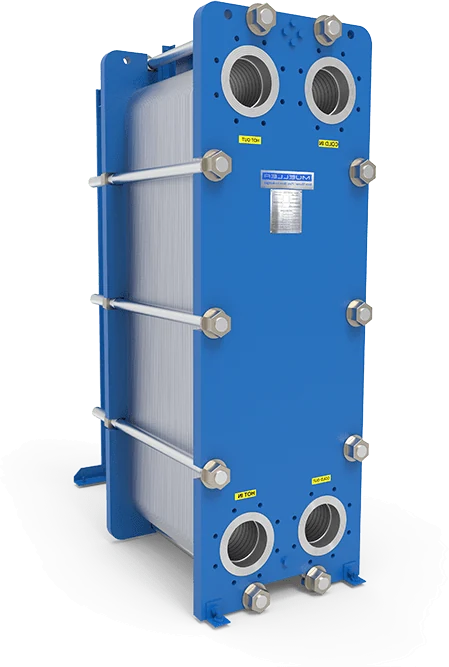
Recombining line conditions
Typical values for a powder-based fluid milk line. Your powder supplier's reconstitution advice and your final heat treatment set the actual figures.
| Condition | Typical value |
| Reconstitution water | 104–122°F |
| Hydration time | 20 minutes or more, agitated |
| Anhydrous milk fat holding | 120–140°F |
| Deaerator feed | a few degrees above vessel boiling point |
| Homogenizing | after deaeration, two stage |
| Pasteurizing | 161°F for 15 seconds, or UHT |
| Product to storage | 36–40°F |
| Plate channel gap | 3–5 mm dairy pattern |
Getting recombined milk through the exchanger cleanly
Air is the main problem
Powder carries air into the mix, and the high-shear mixers that disperse it whip in more. Entrained air comes out of solution on hot plate walls, where the bubbles insulate the surface and let protein bake on behind them. It also foams in the balance tank and makes the homogenizer chatter. A vacuum deaerator ahead of the homogenizer removes it, and the plate section feeding the deaerator heats the base a few degrees above the vessel's boiling point so it flashes on entry.
Fat that sets on cold steel
Melted milk fat dosed into cool reconstituted skim can crystallize on the first cold surface it meets. Plants avoid that by warming the skim base above the fat's melting point before dosing and by heat-tracing the fat line. For the exchanger, that means the preheater ahead of the fat injection point must bring the base up to temperature before blending, not after it.
Sizing the reconstitution water heater
The water heater runs on make-up rate, not on milk rate. A batch plant filling a 5,000 gal mix tank in half an hour needs a heater rated for 10,000 gal/h of water, even if the pasteurizer downstream runs at a third of that. Water is easy on plates, so the pack is short, but hard plant water scales a hot wall; softened or treated water and a heating medium held well below boiling keep the plates clean between cleans.
One frame or several
Small recombining lines often put water heating and deaerator preheating in separate sections of one multi-section frame, with the pasteurizer on its own frame. Larger plants split them so the water heater can keep running while the pasteurizer is in CIP. Either way, the product sections are built like any fluid milk section, to 3-A 11-10 where the inspector expects the symbol.
- Water heater: plain sanitary plate, sized on make-up rate
- Deaerator feed: product section with a tight approach to hold flash temperature
- Pasteurizer: regenerator, heater and cooler, as on fresh milk
Recombining questions
No. Once the powder is fully hydrated and the fat emulsified, the mix behaves in a plate channel like fresh milk of the same fat and solids. The differences show up upstream, in water heating and deaeration, and in somewhat faster heater fouling when hydration was cut short. A standard dairy plate pattern handles the pasteurizing duty.
Not directly in a sanitary plate pack, because steam on the gaskets shortens their life and makes control harder. The usual arrangement is a steam-to-water set that makes hot water, which then heats the reconstitution water through a plate. If that hot-water set is a U-tube shell, it is quoted through our U-tube sister site; the dairy plate stays here.
Run lengths drop and the product suffers. Bubbles on the heater plates give protein a place to bake on, the homogenizer cavitates, and dissolved oxygen speeds oxidized flavor in storage. On powder-based lines the deaerator usually pays for itself in longer runs between cleans, and the exchanger section that feeds it is a small part of its cost.
Often. Many recombined lines feed UHT plants because the product ships to markets without a cold chain, so the final heat treatment may be 275–300°F rather than HTST. In that case the pasteurizing duty leaves the plate and moves to tubular construction, while water heating and deaerator preheating stay on gasketed plates.
Yes, on many lines. The raw side of the regenerator warms the reconstituted base, the base leaves the frame for the deaerator at flash temperature, and it returns after homogenizing to enter the heater section. That needs extra connector plates and ports, and the deaerator temperature then fixes where the regenerator is split into stages.
Related
Dairy Solutions
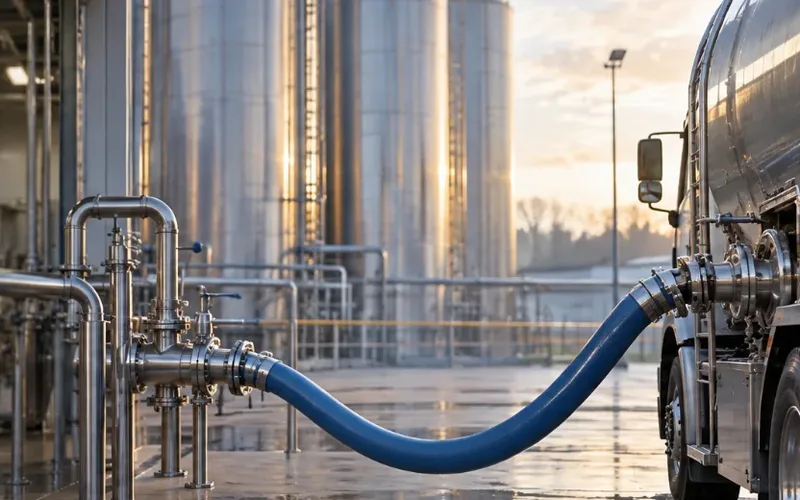
Raw Milk Cooling
A raw milk cooler on the plant receiving line takes tanker milk to 36–40°F before the silo. Plate sizing, chilled water or glycol, and 3-A build.
+ Learn More
Dairy Solutions
HTST & Regeneration
An HTST plate heat exchanger puts regenerator, heater and cooler in one frame. How regeneration percent, the 1 psi rule and the section layout are sized.
+ Learn More
Dairy Solutions
White Milk
White milk processing runs skim, 1%, 2% and whole milk through one HTST frame. Where standardization and the homogenizer sit, and how the pack is sized.
+ Learn More