
1-805-484-2992
Quotes - Engineering - SalesTetra Pak exchangers a dairy buyer meets
Tetra Pak publishes two exchanger families that matter on a dairy floor. The Tetra Pak Plate Heat Exchanger is a gasketed frame, published as an H range in H4, H5 and H8 sizes, with tall, narrow plates and clip-on gaskets. The Tetra Pak Tubular Heat Exchanger is built from tube modules: the maker lists a standard C model, compact S and SA units, and CM multitube modules, combining straight and corrugated tubes.
In one dairy that often means both kinds in one room: a plate frame pasteurizing fluid milk and a tubular line on cultured product, dessert or UHT duty. A request may cover either, and what we need differs. A plate frame is matched by size, plate count and section; a tubular unit by module length, tube bore, tube type and how many modules run in series.
The published tubular design uses floating inner and outer tubes rather than fixed or welded ones, so the tubes can grow with temperature, and an optional spring box that holds tubes without internal dividers. Those details tell us how a module comes apart and what a matched new bundle has to fit at each end.
Plate frame or tube module: what to record
Record whichever applies. Most plants with a tubular line can read module count and tube size off the installation drawing faster than off the unit itself.
Read off the equipment
- Plate frame: Size from the nameplate, plates per section
- Safety groove: Any section weeping at the groove
- Tube module: Length, outer tube bore, inner tube count
- Tube type: Straight, corrugated or multitube insert
- Modules in series: Heating, cooling and any heat recovery counted apart
- Connections: Clamp size and orientation at each end
What we supply
- New plates and gaskets: Made to fit the plate frame, section by section
- New tube bundle: Inner tubes matched to the module
- Equivalent tubular unit: Single, multi or corrugated tube-in-tube
- Needed to quote: Product, particulates, flow, temperatures, utility
- Code: 3-A 12-08 tubular or 3-A 11-10 plate where required
A weep at the safety groove means a gasket has let go
The clip-on design puts a groove between the seals so a failed gasket shows on the outside of the frame. Treat a weep there as the start of a plate and gasket order, not a drip to wipe off.
Tubular modules for cultured and UHT duty
Broken yogurt, fruit preparations and dessert bases carry viscosity or pieces that a plate channel will not pass. A tube-in-tube unit runs them through one open bore, and corrugation lifts the film coefficient without adding contact points. Corrugated tube for cultured product covers the shear question.
For UHT the tube wall carries pressure that a gasket would struggle to hold for long. A milk UHT duty at 275–300°F for 2–6 seconds is where most plants run tubes, and where we quote a tube-in-tube module or a UHT and high-pressure shell matched to the line.
Plate frames on fluid milk
On HTST milk at 161°F for 15 seconds, an H-range frame set up for pasteurizing is a multi-section press like any other: regenerator, heater and cooler between connection plates. We match each section separately, because the regenerator plates wear on a different schedule from heater plates that see hot water every run.
Tall, narrow plates give a long flow path per pass, which helps regeneration but means a plate a few millimeters out of flat will not seal. If plates have been bent during a pack change, order new plates for that section rather than new gaskets alone.
Call and talk it through with an engineer: 1-805-484-2992
Source note: Tetra Pak is a trademark of its owner; the name is used on this page for equipment identification only. The plate and tubular range names come from the maker's own published product pages as read in October 2026, and data the maker leaves unpublished is not stated here.
Swap or new unit
We supply new tube bundles and complete equivalent tubular units. For a bundle, send the module length, outer and inner tube sizes, tube type and end connection, plus a drawing if the plant has one. Where the module uses a spring box or a multitube insert, a complete equivalent module is often the cleaner order.
Probably. After the break, yogurt and other cultured product lose body each time they pass a tight plate channel. A low-shear tubular unit, usually corrugated tube-in-tube, cools the broken curd to about 40–45°F without that texture loss. We quote it as an equivalent new unit and leave the plate frame on milk.
Only the size line. The size fixes plate dimensions and port bore; beyond that we need the same section-by-section plate count, gasket compound and duty data as for any frame. Send a nameplate photograph and the number of plates between each pair of connection plates, and we can quote plates, gaskets or a complete unit.
Nitrile, or HNBR where the same section also sees hot CIP chemistry. Fat swells EPDM, and a swollen gasket pushes out of its groove and weeps at the safety groove within months. EPDM stays the right choice for sections heated with hot water or steam-heated water.
Related
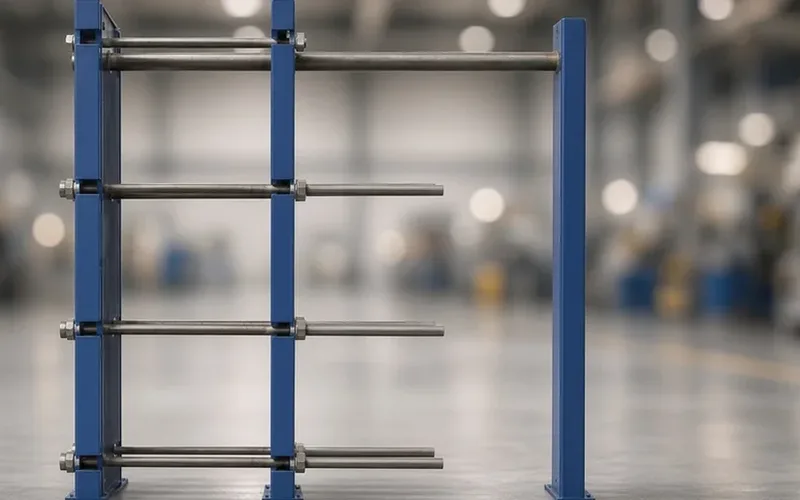
Sizing & Selection
Look Up by Manufacturer & Model
Plate heat exchanger replacement by model: find the make on your nameplate, see what to read off its frame, and request new plates, gaskets or a unit.
+ Learn More
Sizing & Selection
Read the Nameplate
How to read a plate heat exchanger nameplate or a tubular unit's plate: serial, model, design pressure and temperature, year, and what to photograph.
+ Learn More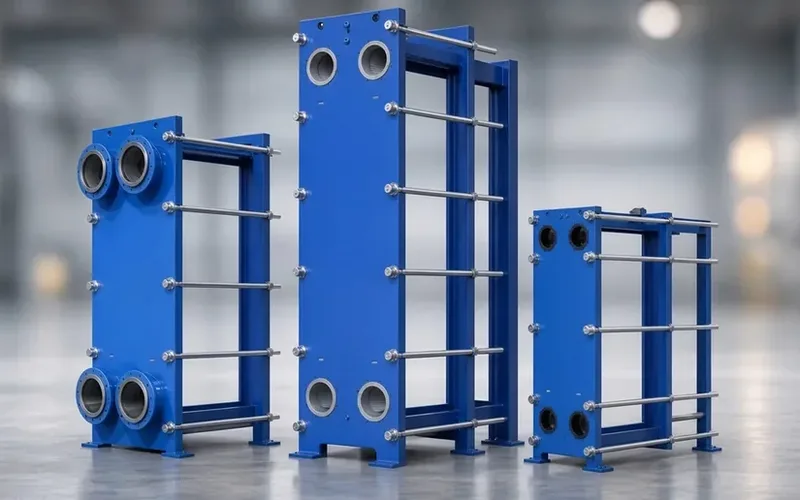
Sizing & Selection
Plates, Gap & Passes
How a replacement pack is matched: plate heat exchanger plate count, plate model, gap, chevron, passes, port size and the compression dimension.
+ Learn More