
1-805-484-2992
Quotes - Engineering - SalesWhy yogurt base is not pasteurized like milk
The heat treatment makes the texture, not only the safety
Milk is pasteurized at 161°F for 15 seconds. A yogurt base is taken to 185–195°F and held for 5 to 10 minutes, far past the legal minimum, because the extra heat unfolds the whey proteins and binds them to casein. That is what gives set and stirred yogurt a firm gel that holds its water without added stabilizer. A base that is merely pasteurized sets weak and weeps.
The base is also richer than milk. Skim or whole milk is fortified with milk powder or protein concentrate to 12–16 percent solids, and often carries sugar and stabilizers, so it is thicker on a plate and fouls a hot wall faster than fluid milk. Homogenizing the base warm, before the heater, spreads the fat so it does not separate during incubation.
After the hold, the base is cooled to the culture's temperature, about 108–112°F, and sent to the incubation tanks or the cups. The frame that does the heating also does most of the cooling through regeneration.
See the Multi-Section Frames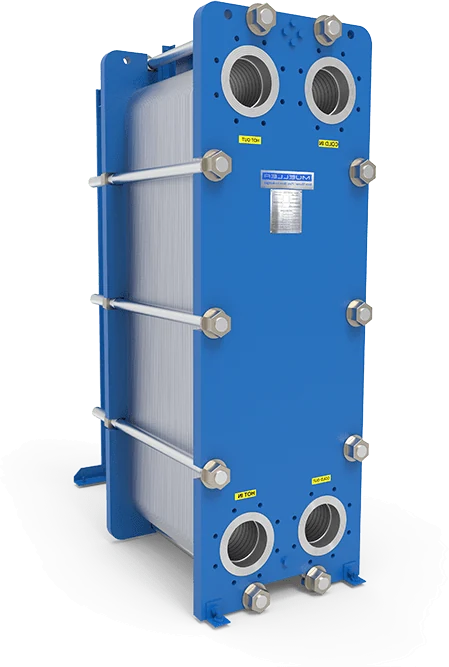
Yogurt base duty
These are the starting figures. Culture suppliers set the incubation temperature and the plant's texture target sets the hold, so send both with the request.
| Step | Typical value |
| Base solids | 12–16 percent, fortified |
| Homogenizer feed | about 140–160°F, ahead of the heater |
| Heat treatment | 185–195°F |
| Hold | 5–10 minutes in a holding tube or vessel |
| Cooled to incubation | 108–112°F for set and stirred yogurt |
| Regeneration | about 70–85 percent with a warm outlet |
| Heater utility | hot water a few degrees above the outlet |
| Base exchanger | gasketed plate frame, multi-section |
| Gaskets | EPDM; NBR on high-fat or cream-added bases |
Sizing the base pasteurizer
The hold lives outside the plates
Five minutes at 3,000 gal/h is 250 gallons in residence, far more than a plate pack holds. The heater brings the base to temperature and a holding tube or a jacketed hold tank keeps it there; the plates then take it back for regeneration and cooling. Some plants heat in the vat and hold there, which turns the exchanger into a cooler alone. Tell us which hold the plant uses, because it changes what the frame has to do.
Regeneration with a warm outlet
A fluid milk frame regenerates to 90 percent or more because its outlet is cold. A yogurt base leaves at incubation temperature, so the pasteurized stream can only give up the heat between 190°F and about 110°F before it would undercool. That caps regeneration near 70 to 85 percent, the heater carries more of the duty than on a milk line, and a trim section on tempered water holds the outlet steady for the culture.
- Base recipe: solids, fat, sugar and stabilizer
- Flow and the hours per batch or per day
- Heat treatment temperature and hold time
- Incubation temperature the culture supplier specifies
- Whether the hold is a tube, a tank or the vat
Fouling at 190°F
Whey protein starts to deposit on a hot wall well before 190°F, and a fortified base carries more of it then milk. Two things slow the deposit: hot water held only a few degrees above the base, and a plate velocity high enough to scour. Both cost a little area. We size the heater for the run length the plant needs between cleanings rather than for the shortest plate count, and we say on the quote which run length it was sized for.
What happens after incubation
Once the gel has set and is broken for stirred yogurt, it is cooled on a tubular exchanger rather than on plates, because broken gel loses body under shear. That cooler and the fruit and piece handling around it are on yogurt and cultured product; this page stays with the base pasteurizer ahead of the culture. Both are usually quoted together.
Yogurt pasteurization questions
Only if it was sized for it. A base is thicker, hotter and holds longer than milk, and the outlet is warm instead of cold, so the heater is larger and the regenerator smaller than a milk frame of the same flow. A milk frame run on base reaches temperature at a reduced flow and fouls sooner. Tell us both duties if one frame has to do both.
The heat treatment covers it. 185–195°F for several minutes is far above 161°F for 15 seconds, and the regulator reviews the yogurt line's recorder and hold the same way it reviews a milk pasteurizer. The flow-diversion and recording controls belong to the pasteurizer builder; our frame is sized so the hold tube or tank stays within its approved range.
A frame lands the base at 108–112°F within a degree or two, so the culture goes in at the same temperature every batch and incubation runs to a predictable time. Cooling a full tank through its jacket takes longer, drifts batch to batch, and leaves the base warm while it waits, which costs texture.
They start from a richer base, often with protein concentrate added, and some are concentrated after incubation instead. The richer base fouls faster and is thicker in the channels, so the heater gets a wider plate gap or a lower approach. Send the recipe and the plant's run length and we size the frame for it rather than for plain yogurt.
Related
Dairy Solutions
Cheese Milk
Cheese milk heat exchanger for pasteurizing or thermizing, then trimming the milk to vat set temperature. Plate frame sizing, regeneration and outlet control.
+ Learn More
Dairy Solutions
Yogurt & Cultured Product
Tube in tube yogurt cooling after the break, plus plate heating of the milk base to 185–195°F and cooling to incubation temperature.
+ Learn More
Dairy Solutions
Sour Cream
Sour cream processing heat exchangers: NBR-gasketed plate to pasteurize the cream and reach culture temperature, tubular cooling once it has cultured.
+ Learn More