
1-805-484-2992
Quotes - Engineering - SalesThe exchanger sets up the churn
Pasteurize hot, then cool on a program
Cream for butter runs 35–45 percent fat and is pasteurized far above the 166°F legal floor for high-fat products. Many butter plants heat to 190–205°F for a few seconds, enough to kill lipase-forming organisms and inactivate the enzymes that would turn stored butter rancid, often with a vacuum deaerator in the line to pull off feed and weed flavors.
What happens after the heater decides the butter's texture. Butterfat is a blend of hard and soft triglycerides, and the rate and temperature at which the cream is cooled control how much of it crystallizes and in what form. A fast drop to the first ripening temperature produces many small crystals; the ripening tank then holds the cream for hours while those crystals grow. If the exchanger cannot reach that first temperature at full flow, the program is already off before the tank sees the cream, and the plant finds out at the churn as soft, greasy butter or fat lost to the buttermilk.
So the cooling section matters more on a butter line than on a bottling line. It is laid out to land one temperature precisely, not just to get the cream below 45°F.
See the Multi-Section Frames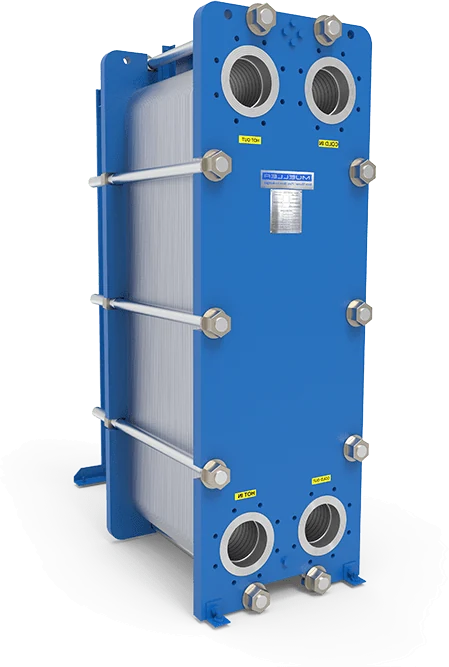
Butter cream heating and cooling values
Ranges seen on sweet cream and cultured butter lines. Your ripening program, written for your own summer and winter fat, sets the final numbers.
| Condition | Typical value |
| Cream fat | 35–45%, set at the separator |
| Legal minimum | 166°F for 15 seconds |
| Common pasteurizing point | 190–205°F for a few seconds |
| First ripening temperature | Set by the program for hard or soft fat |
| Churning temperature | Typically about 46–57°F |
| Cultured butter inoculation | About 64–70°F, then cooled after souring |
| Gaskets | NBR product side, HNBR at the heater, EPDM on water |
| Frame layout | Regenerator, heater, deaerator ports, staged coolers |
| Product-side build | 316L, tri-clamp, 32 Ra, 3-A 11-10 where required |
Designing the butter cream frame
High heat and the hot-water loop
Heating cream near the top of that range needs hot water within a few degrees of boiling, so the loop usually runs pressurized, more so at altitude. Regeneration recovers most of that heat on the way back down. When a vacuum deaerator is fitted, the frame needs outlet and return connections between regenerator and heater so the cream can leave, be stripped and come back; that is one reason butter lines suit a multi-section frame with intermediate connector plates.
The hold at those temperatures is short, a few seconds rather than the 15 required at 166°F, so the holding tube is compact and the recorder at its outlet reads close to what the heater delivers. A heater approach of 2–5°F keeps the plate wall from scorching high-fat cream between cleanings.
Gaskets against butterfat
Butterfat is absorbed in to EPDM, which swells, softens and eventually extrudes from the groove. Nitrile resists the fat and is the usual product-side compound on a butter line. At the heater, where cream sits near 200°F through every run, some plants move up to HNBR, which handles both the fat and the heat with more margin than standard nitrile.
Landing the first ripening temperature
Physical ripening begins in the exchanger, so the cooler is sized for the program rather than a generic outlet.
- Tell us the ripening program, not just one final temperature
- Size the cold section for the coldest step at full flow
- Allow 5–8°F of approach if the last section runs on glycol
- Ask for a tempered-water section when the program warms cream again
Sweet cream and cultured butter
For cultured butter the cream leaves the exchanger at culture temperature, about 64–70°F, is inoculated in the tank and ripened there before cooling. A plant making both styles may need two outlet set points from one frame, which is a staging question we settle at sizing. Where a regulator or customer asks for a separate barrier between raw and pasteurized cream, see double wall or single.
Butter cream notes
Butter keeps for months, so anything that survives in the cream has time to act. Higher heat kills the organisms that produce lipase and inactivates enzymes that would split fat into rancid free fatty acids. Combined with deaeration it also drives off feed flavors. The limit is cooked flavor, which is why most plants hold only a few seconds at the top temperature.
Fewer, larger fat crystals form and more of the fat stays liquid into the churn. The butter comes out soft and greasy, takes longer to work, and more fat escapes into the buttermilk. A cooler that loses a few degrees late in a run, as plates foul, produces exactly that pattern, so we size the cold section with a fouling margin.
Usually, since both are high-fat cream on nitrile gaskets. The set points differ: table cream needs only 166°F and a cold outlet near 40°F, while butter cream runs hotter and leaves at its ripening temperature. We confirm the hold, the heater approach and the cooling staging work at both conditions before calling the frame dual-purpose.
More closely than a bottling line asks. A drift of two or three degrees at the first ripening step changes the crystal pattern the tank builds on, and the churn shows it. We size the cold section to hold its set point at the end of a run, with a control valve on the utility side rather than on the cream, so the product path stays open and unthrottled.
Related
Dairy Solutions
Cream Heating
A cream heat exchanger sized for heavy cream: wide-gap plates above about 30 percent fat, 166°F pasteurizing and cooling that protects the fat.
+ Learn More
Dairy Solutions
Ice Cream Mix
An ice cream mix pasteurizer heats mix to 175°F for 25 seconds, then cools it for the aging tank. How sugar, stabilizer and solids shape the exchanger.
+ Learn More
Dairy Solutions
Cream & Ice Cream Mix
Cream heat exchanger and ice cream mix exchanger selection: when fat and viscosity move a dairy duty from standard plates to wide-gap or tubular.
+ Learn More